

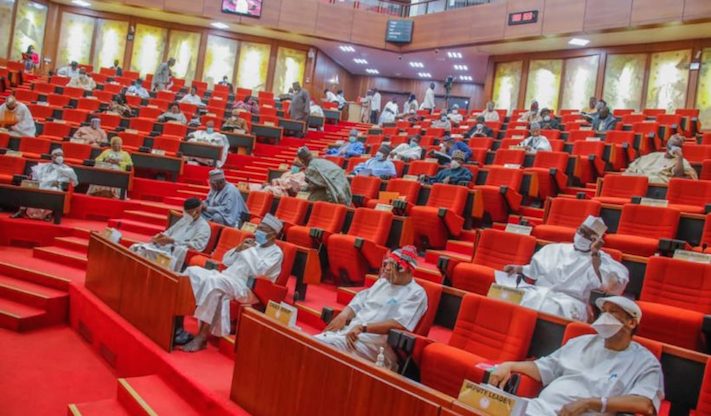
In the annals of Nigeria’s democratic history, the year 2025 will be remembered for intense legislative activity, political controversy, institutional challenges and structural reform.
Under the leadership of Senate President Godswill Akpabio, the Senate pursued ambitious goals while finding itself at the center of some of the nation’s most consequential debates, from economic restructuring to security strategies, from public scandals to constitutional reconsideration.
Below, we examine the 10 key developments that shaped the Nigerian Senate in 2025.
1. Tax Reform Legislation and Economic Overhaul
One of the most defining features of the Senate’s work in 2025 was its role in tax reform, a central element of President Bola Tinubu’s economic agenda.
Tax reform bills aimed at overhauling Nigeria’s revenue framework were debated, renegotiated and prioritised throughout the first half of the year, and they sparked controversy almost immediately after introduction.
Read also: NDDC proposes N1.75trn 2025 budget as Senate begins physical assessment of projects
The Senate’s scrutiny and eventual passage of crucial tax legislation, including increases in value‑added tax and revisions to oil revenue frameworks, were seen as necessary steps toward fiscal sustainability and resilience.
These reforms were intended to increase government revenue, narrow fiscal gaps and reduce decades of dependency on oil receipts, a chronic structural weakness in the Nigerian economy.
However, the bills also drew strong objections from labour unions, professional associations and civil society actors who argued that the measures could place undue economic burden on ordinary Nigerians, even as the Senate attempted to moderate provisions and incorporate stakeholder feedback. After months of committee hearings, stakeholder engagements and closed‑door negotiations, the Senate passed the bills in mid‑2025, with lawmakers defending the reforms as painful but essential for long‑term fiscal stability.
What followed the passage of the bills proved even more consequential than their legislative approval.
Almost close to the January 1 implementation, fresh controversy erupted over alleged alterations to the bills after they were approved.
Lawmakers, civil society groups and some governors claimed that key provisions relating to VAT distribution, tax exemptions and compliance thresholds were changed between passage and transmission to the presidency. Senior senators such as Ali Ndume publicly urged President Tinubu to suspend implementation, warning that trust in the legislative process was at stake. The Senate leadership firmly denied wrongdoing, insisting that the versions sent to the executive reflected what was approved on the floor, but the controversy cast a long shadow over the Senate’s tax reform efforts.
2. The Akpabio‑Natasha Scandal
No episode drew more sustained public attention than the suspension of Senator Natasha Akpoti‑Uduaghan following her clash with Senate President Godswill Akpabio over Senate seating arrangements and broader conduct issues. What began as a procedural disagreement over internal chamber arrangements escalated into a full‑blown political crisis that included sexual harassment accusations, disciplinary action, legal battles and public demonstrations.
Akpoti‑Uduaghan had previously lodged a petition alleging inappropriate conduct by Akpabio. The Senate leadership, acting on a report from the Ethics and Privileges Committee, suspended her for six months for alleged misconduct during plenary and alleged refusal to comply with committee directives and standing orders.
The Senate leadership denied that the suspension was connected to her petition or personal accusations, framing it instead as a disciplinary response to breaches of Senate rules.
Akpoti‑Uduaghan challenged the suspension in court and filed legal action against the Senate leadership and Akpabio, arguing that the disciplinary measures were unjust and improperly applied. In one high‑profile development, a judge recused himself from hearing her lawsuit because of alleged bias, underscoring the complexity and sensitivity of the legal battle.
The legal fight continued until her six‑month suspension ended, and multiple cases arising from the controversy remained before the courts by year’s end.
The scandal drew attention well beyond legal filings. Akpoti‑Uduaghan defied security protocols to enter the National Assembly complex with supporters, including civil society activists, as she protested her suspension and described it as political persecution. The dispute also drew the interest of the Inter‑Parliamentary Union.
Read also: Senate passes N43trn 2024, 2025 appropriation repeal and re-enactment bills
3. Institutionalising National Traditions: The June 12 Presidential Address
In mid‑2025, the Senate took steps to institutionalise an annual presidential address on June 12, Nigeria’s Democracy Day, to be delivered in the National Assembly complex.
This proposal was not merely ceremonial. It was designed to reinforce democratic culture, position the legislature as a central arena for national reflection and signal a renewed commitment to democratic ideals rooted in Nigeria’s return to civilian rule.
For many senators, institutionalising the June 12 address represented a landmark opportunity to elevate public engagement with democratic rituals and strengthen the symbolic relationship between the executive and the legislature.
It also underscored the Senate’s role in shaping national narratives and reinforcing the constitutional framework that underpins Nigeria’s democracy.
4. Senate Backing of the Rivers State Emergency Rule
In March 2025, Nigeria’s political spotlight turned decisively to Rivers State, an oil‑rich South‑South region where prolonged political crisis fractured governance and raised serious security, economic and constitutional concerns. President Bola Ahmed Tinubu invoked Section 305 of the 1999 Constitution as amended and declared a six‑month state of emergency in Rivers State, suspending the elected governor, deputy governor and all members of the state House of Assembly, and appointing retired Vice Admiral Ibok‑Ete Ekwe Ibas as Sole Administrator.
Under the Constitution, a presidential state of emergency must be endorsed by the National Assembly. After initial procedural debates and questions about attendance, the Senate convened in a closed session on March 20, 2025, with Senate President Akpabio reading the president’s letter requesting approval of the emergency proclamation. The Senate invoked its constitutional powers to ratify the declaration and authorise its continuation for up to six months, with provisions for earlier review or termination.
During deliberations, the Senate also resolved to establish an ad‑hoc National Assembly committee to oversee and monitor the emergency rule, ensuring oversight of the Sole Administrator’s functions and safeguarding public interests during the suspension of elected government.
Following constitutional endorsement, the Senate reviewed and approved Rivers State’s ₦1.48 trillion 2025 appropriation bill under emergency rule, citing the unusual political situation and the need to protect the welfare of the state’s citizens.
Senate Majority Leader Opeyemi Bamidele emphasised that emergency rule was not a substitute for democratic governance but a constitutional tool to restore order, stability and peace where normal governance had broken down.
The Senate’s endorsement of the emergency rule, however, drew broad criticism from opposition figures and civil society, who argued that the suspension of an elected government posed risks to democratic norms. Former presidential candidate Peter Obi described the emergency declaration as “unconstitutional and reckless,” saying that suspending elected officials undermined Nigeria’s democratic trajectory.
As the emergency rule unfolded, Rivers State continued under the Sole Administrator’s authority while the National Assembly’s oversight committee acted as a legislative check. Public debate over the propriety of the intervention remained intense. By September 2025, the six‑month period had elapsed, President Tinubu formally ended the state of emergency, and Governor Siminalayi Fubara, his deputy and the Rivers State House of Assembly were reinstated.
Read also: Senate passes Tinubu’s ₦58.47trn 2026 budget for second reading
5. Defections to the APC in the National Assembly
Defections to the All Progressives Congress (APC) were among the most consequential political developments in the Nigerian Senate in 2025, significantly altering the balance of power in the National Assembly and weakening opposition influence, particularly that of the Peoples Democratic Party (PDP).
At the beginning of the year, the Senate remained relatively competitive, with APC, PDP, Labour Party and other parties represented. However, sustained defections throughout 2025 steadily tilted the chamber in favour of the ruling APC. Lawmakers cited internal crises in their former parties, lack of cohesion and the need to align with the federal government’s policy direction as reasons for defecting.
Key moments included the departure of several PDP senators from states such as Osun, Akwa Ibom, Bayelsa, Cross River and Rivers, and at least one senator from the Labour Party. These moves were formally announced on the Senate floor during plenary sessions, often with APC leadership present, underscoring the political symbolism of the realignments.
By year’s end, the APC had grown its strength in the Senate to close to 80 seats, comfortably surpassing the two‑thirds majority threshold, while the PDP’s numbers dwindled to about two dozen senators, sharply reducing the opposition’s ability to influence debates, contest leadership positions or oppose government‑backed legislation effectively. Smaller parties were left with limited leverage.
The practical and symbolic consequences were far‑reaching. With its overwhelming majority, the APC drove its legislative agenda, dominated committee leadership and shaped key decisions on sensitive national issues. For the PDP, the loss of senators deepened perceptions of internal instability and raised questions about its ability to function as a strong opposition ahead of the 2027 elections. The wave of defections transformed the Senate into a chamber firmly controlled by the ruling party, reshaping legislative politics and highlighting the fragility of party loyalty in Nigeria’s democratic system.
6. Security Debates and the Push for a National Security Summit
Persistent insecurity, from banditry and insurgency to communal violence forced security to the forefront of Senate deliberations in 2025.
Nigeria’s worsening security landscape, particularly in the North‑East, North‑West and parts of the South, made legislative engagement with security priorities a necessity, not a choice.
In response, the Senate established a special committee to organise a national security summit, bringing together federal, state and non‑state actors to reassess Nigeria’s security architecture, evaluate institutional capacity and consider strategic interventions.
While critics dismissed the summit as symbolic, supporters argued it represented a legislative attempt to move beyond reactive lawmaking toward coordinated national strategy.
The Senate used the platform to interrogate budgetary allocations to the military, police and intelligence agencies, question implementation gaps and emphasise the need for clear frameworks to guide operations. Through hearings and public hearings, lawmakers sought to hold the executive accountable and promote legislative engagement in security policymaking.
7. Screening of Ambassadorial Nominees
The Senate’s screening of President Bola Tinubu’s late ambassadorial nominees was overshadowed by intense controversy surrounding the nomination of Reno Omokri as a non‑career ambassador, turning the confirmation process into one of the most divisive episodes in the chamber in 2025.
Tinubu submitted 65 nominees to the Senate, made up of 34 career diplomats and 31 non‑career appointees. While the career nominees were largely screened without incident, Omokri’s inclusion on the politically exposed list triggered sustained resistance from lawmakers. Objections focused on Omokri’s past public statements, particularly his description of Tinubu as a “drug baron,” which several senators argued he neither retracted nor sufficiently clarified. Opponents maintained that someone who had publicly questioned the integrity of the president could not credibly represent Nigeria or the presidency abroad, regardless of political realignments.
The disagreement spilled beyond formal proceedings, with exchanges on internal Senate platforms becoming so tense that senior lawmakers had to intervene to restore order. What initially appeared to be a moral and procedural objection soon revealed deeper political and regional undercurrents within the chamber, particularly among South‑East senators.
Resistance was especially pronounced among the caucus led by Senator Osita Ngwu of Enugu, who argued that the matter was about preserving the sanctity of the presidential office and Nigeria’s diplomatic image. In messages circulated among colleagues, he insisted that public attacks on the presidency should have consequences in matters of national representation.
Although the Senate proceeded with the broader ambassadorial screening through the Committee on Foreign Affairs, the Omokri episode left a lasting imprint on the process. It exposed internal tensions and reinforced the growing insistence that ambassadorial appointments should meet not just political considerations but standards of restraint, loyalty to state institutions and diplomatic credibility.
One dramatic moment occurred during the screening when Senators Adams Oshiomhole of Edo North and Ali Ndume of Borno South openly clashed over procedure and political motive, underscoring how deeply divided senators were over the nomination.
Read also: Senate confirms 64 ambassadorial nominees, including Fani-Kayode, Reno Omokri
8. The 2026 Budget and Overlapping Budgets Complaints
The 2026 Federal Government budget was a central focus of legislative activity in late 2025, as the Senate reviewed the proposed ₦58.47trillion Appropriation Bill presented by President Tinubu to a joint session of the National Assembly in late December. Lawmakers welcomed the emphasis on infrastructure, security, education and social services while assessing deficit and macroeconomic parameters. The bill was committed to the Senate Committee on Appropriations for detailed analysis against the 2026–2028 Medium‑Term Expenditure Framework.
The President also promised to end running multiple budgets by March, 2026.
However, budget discussions were dominated by complaints about overlapping budgets and fiscal discipline. Senators from both the majority and the opposition expressed deep unease about Nigeria’s continued practice of implementing multiple budgets in the same fiscal cycle, a phenomenon that had characterised the nation’s public finances since 2024.
Lawmakers criticised the recurrent rollover of capital projects and the concurrent operation of extended 2024, 2025 and 2026 budget cycles, warning that the practice undermines fiscal discipline, erodes public confidence and weakens transparency and accountability in public spending. Senators also questioned why previously approved borrowings were not utilised earlier to support execution, highlighting weak capital project implementation and shaky revenue assumptions underlying the budget.
The chamber also approved the repeal and re‑enactment of the 2024 and 2025 Appropriation Acts, extending implementation of the 2025 budget to March 31, 2026, to provide legal backing for capital spending while the 2026 budget was finalised. Critics stressed that without addressing persistent structural revenue gaps, overlapping budgets would continue to jeopardise fiscal discipline and effective governance.
9. Legislative Oversight and Key MDAs Accountability
Throughout 2025, committees of the Senate scarcely held extensive interactive sessions and public hearings with ministries and agencies including health, education, infrastructure, transport, and the economy, ensuring that allocated funds were appropriately spent and performance targets met. The sessions held were often laced with praise-singing of ministers and agency heads about expenditure, project timelines and compliance with budgetary frameworks.
The Senate’s oversight function was robust and visible, reflecting an institutional assertiveness that insisted on accountability and performance evaluation, not just budget approval. Unlike previous Assemblies, the 10th Assembly has constantly failed to expose implementation gaps and pushed MDAs to justify their operational and capital spending.
10. Constitutional Review and National Consultations
In 2025, the Senate intensified efforts on constitutional review, embarking on an ambitious nationwide consultation process to gather input from Nigerians on institutional reforms, fiscal governance and democratic strengthening. Throughout the year, constitutional review committees held meetings across the country, engaging stakeholders including civil society organisations, traditional rulers, youth groups, academia and ordinary citizens.
These consultations focused on issues including revenue sharing, budget timelines, executive‑legislative relations, public accountability mechanisms and the need to prevent recurring overlaps in budget implementation.
The process was designed to ensure that constitutional amendments reflected broad‑based input and addressed structural challenges that have hindered effective governance and financial discipline.
The Senate’s constitutional review agenda underscored a recognition that some of the most pressing issues in Nigeria’s governance, from fiscal indiscipline to institutional checks and balances, required amendments to the foundational legal framework. By taking the review to the grassroots, lawmakers sought to democratise constitutional reform and ensure that the resulting proposals were grounded in public demand.
