

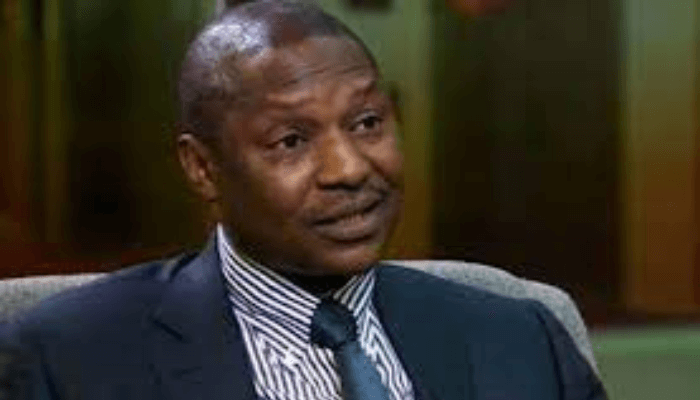
A Federal High Court sitting in Maitama, Abuja has remanded former Attorney-General of the Federation and Minister of Justice Abubakar Malami, his son Abdulaziz Malami and his wife Bashir Asabe in Kuje Correctional Center pending judgment on their bail petitions.
Emeka Enwite (Justice) on Friday adjourned the case to January 7, 2026, for the court to give its judgment on the applications filed by the defendants, who are standing trial over alleged money laundering offenses amounting to N8.71 billion.
The trio are being prosecuted by the Economic and Financial Crimes Commission (EFCC) on a 16-count charge relating to conspiracy, procurement, concealment, concealment and laundering of illegal activities contrary to the provisions of the Money Laundering (Prevention and Prohibition) Act, 2022.
Iheanacho alone in hearing resumed
The prosecution counsel informed the court that the case was scheduled for hearing of the bail petitions filed by the defendants.
Also read: EFCC charges Malami, wife, son over alleged N8.7bn money laundering
However, defense counsel, JB Dawdu, SAN, told the court that the prosecution had just served the counter affidavit to the defense in court, which needed time to study and respond.
Dauddu later filed a counter affidavit of about 28 to 30 paragraphs, challenging the continued detention of the defendants and urging the court to grant them bail.
In response, Iheanacho told the court that the prosecution had yet to be served additional affidavits and replies on points of law from the defense and needed time to study the procedures.
“We were given a counter affidavit and asked for time to go through the procedures, O Lord.
“We have now been served with another affidavit, each of which has about 28 to 30 paragraphs, as well as a reply on points of law. I have not seen what they have filed and may need time to do so,” Iheanacho said.
Daudou opposed the request, arguing that the case was adjourned for a one-day sitting with at least one working day in between, and stressed that there was no justification for prolonging the defendants' detention.
He requested the court to allow a brief period, if necessary, for the prosecution to respond and proceed with the trial.
Responding, Iheanacho said that the prosecution did not intend to detain the defendants without any justification, but that the amount of procedures needed to be carefully considered.
“It is better to hurry slowly,” he said.
After exchanges and no objection from either party, the court rejected one application and granted the other, as prayed by the defence.
Dauddu urged the court to grant bail to the three defendants.
He prayed that the first defendant, the former Attorney-General of the Federation, be admitted on self-recognition, while the second and third defendants be granted bail on liberal terms.
He pointed out that Malami's application was supported by a 36-paragraph affidavit dated December 29, 2025, by his son Nuzain Malami, which was accompanied by a written address accompanied by several exhibits.
The second respondent's application was supported by a 28-paragraph affidavit given by his daughter Farida Abdullahi Usman, he said, while the third respondent's application was supported by a 39-paragraph affidavit given by his brother.
Dawdu argued that the crimes were bailable and the defendants were considered innocent until proven guilty.
He rejected allegations that they may interfere with witnesses, describing such allegations as speculation and saying that the EFCC had previously granted administrative bail to the defendants during investigations.
He urged the court to exercise its discretion in favor of the defendants, saying, “It is contradictory for a party that granted administrative bail to now be arguing otherwise.”
Opposing the applications, Iheanacho told the court that the EFCC had filed three separate counter affidavits dated January 2, 2026, which were presented by an operative of the commission, Adebayo Daniel, and supported by written addresses.
He argued that the main statements in the counter affidavit, particularly the allegations of interference with witnesses and evidence by the first and second defendants, were not refuted by the defence.
He argued that unchallenged facts are considered accepted.
According to the prosecution, interference with witnesses goes to the root of a fair trial, urging the court to invoke relevant provisions of the Administration of Criminal Justice Act (ACJA) in denying bail.
Iheanacho also said that bail granted during investigation is different from that sought after charges are filed in court.
“The presumption of innocence does not give an automatic ticket to bail,” he said.
Nwite acknowledged the number of cases before the court during the holiday period, but assured the parties that justice would be delivered without any delay.
“I have several high-profile cases before me during this vacation period, but justice will be delivered in the shortest possible time,” the judge said.
According to a statement by Dele Oyewole EFCC spokesperson, the court adjourned the case to January 7, 2026 to adjudicate on the bail applications.
