

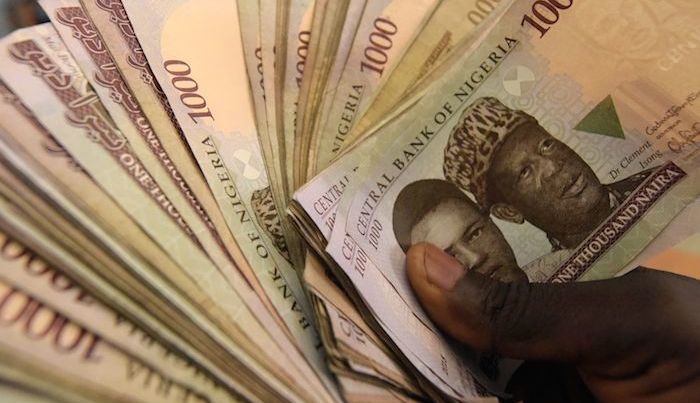
The five-trading foreign exchange market ended on Friday with the Nigerian currency up 0.39 per cent against the dollar on the black market, but the disparity in exchange rates between the official and alternative markets remains a concern.
…exit list after almost two years
Nigeria's naira dropped out of the list of Africa's 10 worst performing currencies in 2025, ending nearly two years off the ranking due to a sharp devaluation leading to instability and foreign exchange shortages.
An analysis using the Forbes currency calculator shows Africa's most populous country dropped out of the bottom ten list in October 2025 and did not come out again until December, supported by improving external reserves, policy reforms and improved liquidity conditions.
Although the country's exact ranking was not disclosed, by the end of 2025, the Rwandan franc stood at N1,456 per dollar, ranking 10th, while the naira stood at N1,436 as of December 31, potentially placing it among Africa's 15-20 weakest currencies. Data from the Central Bank of Nigeria (CBN) shows that the naira has appreciated by 6.5 per cent year-on-year to more than N1,535.82 in the same period of 2024.
Forbes further revealed that Sao Tome and Principe's dobra was Africa's weakest currency last year at 22,282 per dollar, followed by Sierra Leone's leone (20,970), Guinea franc (8,741), Malagasy ariary (4,577), and Uganda shilling (3,610).
Also read: Naira ends year with over N100 gain as external reserves rise by 11.3 per cent
Other weak currencies included the Burundian franc (2,958), Tanzanian shilling (2,465), Congolese franc (2,200), Malawi kwacha (1,736), and Rwandan franc (1,456).
The recovery in Nigeria follows a period of severe currency stress caused by President Bola Tinubu's early reforms, including the removal of currency controls and massive devaluations in June 2023 and January 2024, which pushed the naira to the top of Africa's weakest currency ranking in early 2024.
According to the World Bank's latest Africa Pulse report, the reforms have reduced volatility and strengthened Nigeria's external position, reflected in rising foreign exchange reserves and a large current-account surplus.
“The more competitive naira is expected to continue to support export diversification and compress imports. However, price pressures are expected to remain elevated, requiring sustained monetary policy efforts to reignite inflation expectations,” the report said.
FX market stabilization reduces inflationary pressures
CBN data shows the average official exchange rate weakening sharply from N645.10/$ in 2023 to N1,450/$ in 2024. In the first eight months of 2025, the naira traded mostly between N1,500 and N1,600 per dollar before consolidating at N1,480.30/$ on September 26, its strongest level in eight months.
Since then, it has remained below N1,500/$.
Nigeria's external reserves—crucial for managing FX volatility—also rose to $45.48 billion by December 30, 2025, the highest in six years, from $40.88 billion a year earlier. In its latest macroeconomic outlook, the apex bank estimates reserves will rise to about $51.04 billion in 2026, supported by improved FX liquidity, higher oil earnings, sovereign bond issuance and strong migrant remittance inflows.
Before dropping off the list, the naira was ranked the ninth weakest currency in Africa as of September, down three places from the previous month (sixth).
“Exchange rate stability emerged as the most visible achievement, with the naira largely trading within the N1,440-N1,500/$ band,” said Muda Yusuf, director general of the Center for the Promotion of Private Enterprise (CPPE).
“The timely marginal appreciation strengthened business confidence, reduced imported inflation and restored predictability to pricing, contracts and investment planning,” he said.
The improved FX stability coincided with a sharp decline in headline inflation, which declined from 24.48 percent in January to 14.45 percent by November. Average inflation also fell to 20.96 percent in 2025, from 33.2 percent in 2024 and 24.66 percent in 2023, reflecting lower currency pressures, lower petrol costs and more stable supply chains.
“There was a sharp decline in prices of many food items and imported consumer goods, which improved consumer sentiment and reduced price volatility,” Yusuf said.
Still, the World Bank cautioned that the path to deflation remains vulnerable to exchange rate pressures, supply shocks, and global market volatility.
Structural developments support the naira
The start-up of the Dangote refinery – the world's largest single-train refinery with a capacity of 650,000 barrels per day – has reduced demand for refined-product imports and FX outflows, with refined-product imports falling to 3.1 million tonnes in the first quarter of last year.
Nigeria's renewed currency-swap agreement with China has further reduced demand for the dollar by allowing trade settlements in yuan and naira. In 2024, Nigeria imported N14.14 trillion ($9.56 billion) worth of goods and services from China and exported over N3 trillion ($2.03 billion).
The CBN expects the capacity of the Dangote refinery to increase to 700,000 barrels per day in 2025, with a medium-term target of 1.4 million barrels per day, thereby reducing import dependence, supporting reserve accumulation and strengthening FX stability.
While the country's naira dropped out of Africa's bottom-ten list, the continent's strongest currencies were led by the Tunisian dinar (2.90 per dollar), followed by the Libyan dinar (5.41), Moroccan dirham (9.11), Ghanaian cedi (10.93), and Botswana pula (13.54).
Others include the Seychellois rupee (14.89), Eritrean nakfa (15.00), Swazi Lilangeni (16.69), South African rand (16.69), and Namibian dollar (16.70), while the Lesotho loti rounds out the top ten at 16.71 per dollar.
