
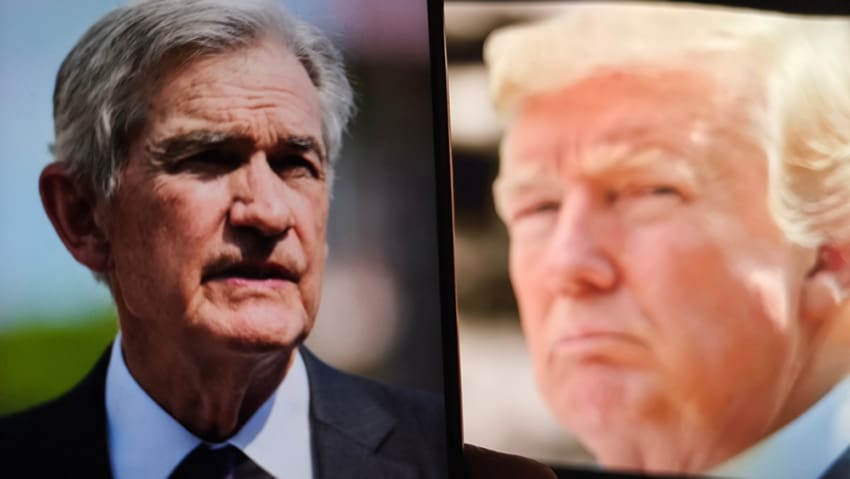
Donald Trump's escalating confrontation with the US central bank has sent global markets into shock, sending gold to an all-time high as investors sought to avoid rising political risks in the world's largest economy.
Gold rose to nearly $4,600 an ounce on Monday, while silver near record levels as fears grew over political interference in the independence of the Federal Reserve. The US dollar weakened sharply, with the dollar index falling 0.32 per cent against major currencies.
The flight to safe-haven assets followed comments by Jerome Powell, who said the criminal investigation into his conduct was part of an effort to intimidate the central bank and weaken its ability to set interest rates free from political pressure.
Despite the turmoil, Wall Street stocks rose modestly. The S&P 500 rose 0.16 percent, the Dow Jones Industrial Average rose 0.17 percent and the Nasdaq climbed 0.26 percent. Bond markets were more volatile, with the yield on the benchmark 10-year US Treasury rising to 4.18 percent as investors questioned the long-term credibility of the US monetary administration.
In the UK, the FTSE 100 was slightly up, while sterling strengthened to $1.34 against the dollar, reflecting broader weakness in the greenback.
Market volatility rose sharply, with the VIX index posting its biggest rise since November as investors grasped the implications of an unprecedented standoff between the White House and the Fed.
Late Sunday, Powell confirmed that the US Justice Department had issued grand jury subpoenas related to his testimony on the $2.5 billion renovation of the Fed's Washington headquarters. In a rare and direct public rebuke, he warned that the investigation raised fundamental questions about whether monetary policy would be shaped by economic evidence or political pressure.
In a joint statement, Alan Greenspan, Janet Yellen and Ben Bernanke, all living former Fed chairs, described the move as an “unprecedented effort” to erode the central bank's independence, warning that it is similar to practices seen in emerging economies with weak institutions.
Trump, who appointed Powell during his first term, denied direct involvement in the subpoena but reiterated his criticism of the Fed chair's leadership. He is expected to name a successor soon, with Kevin Hassett and Kevin Warsh being seen as the leading contenders.
Economists have warned that the consequences could be profound. Analysts at Berenberg said the US could face a repeat of 1970s-style inflation if political influence dictates monetary policy, while ING and Nomura warned that continued pressure on the Fed would create a sustained downside risk for the dollar.
For businesses and investors globally, the episode has revived a familiar lesson: When confidence in institutions wavers, capital seeks safety. With US inflation still above target and political tensions deepening, the market looks set for more volatility in the coming months.

jamie young
Jamie is a senior reporter at Business Matters, with over a decade of experience in UK SME business reporting. Jamie has a degree in Business Administration and regularly attends industry conferences and workshops. When Jamie is not reporting on the latest business developments, he is passionate about mentoring budding journalists and entrepreneurs to inspire the next generation of business leaders.