
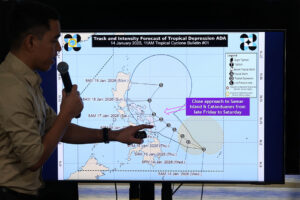

According to the State Weather Bureau on Wednesday, the low pressure area in the east of the country has developed into Tropical Depression Ada. Storm signal number 1 has been raised in many areas.
Ada entered the Philippine area of responsibility at 8:00 a.m. and was last located 635 kilometers east of Hinatuan, Surigao del Sur, the Philippine Atmospheric, Geophysical and Astronomical Services Administration (PAGASA) said in its advisory at 11:00 a.m.
The tropical depression has maximum sustained winds of 45 kilometers per hour (km/h) and gusts up to 55 km/h.
Ada is forecast to intensify into a tropical storm within 24 to 36 hours.
PAGASA raised Storm Signal Number 1 in several areas of the Visayas and Mindanao, including Northern Samar, Eastern Samar and Samar. The signal is also in effect on Dinagat Islands, Surigao del Norte and Surigao del Sur.
Under this signal, PAGASA said minor to moderate impacts from strong winds could be experienced within 36 hours.
It added that Storm Signal Number 2 may be the highest signal raised during the passage of the system.
The Weather Bureau has also issued a forecast of heavy rainfall in the same areas, which will remain in effect till Saturday.
Yellow rain warnings were issued for Eastern Samar, Dinagat Islands, Surigao del Norte and Surigao del Sur, where 50 to 100 millimeters of rain could fall on Thursday.
PAGASA warned of possible local flooding and landslides, especially in disaster-prone areas amid heavy rainfall.
According to Ada's trajectory within the next three days, it may pass near Eastern Visayas or make landfall on Friday or Saturday morning.
The tropical depression may move close to Catanduanes or make another landfall from Saturday to Sunday before turning generally northeast over waters east of Luzon.
Tropical Depression Ada is the country's first tropical cyclone of 2026.
The Philippines experiences an average of about 20 tropical cyclones each year, the most in the world, as it is located along the western North Pacific basin where typhoons are frequent. — Age Adrian A Eva