
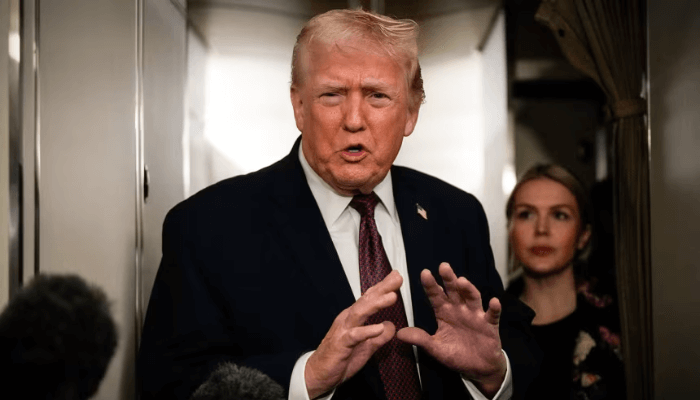
President Donald Trump speaks to reporters on Air Force One en route to Joint Base Andrews, Maryland, on January 11. Julia Demery Nikhinson/AP
Former Permanent Secretary and Minister of Foreign Affairs of Nigeria, Joe Keshi, has cautioned that the United States (US) is specifically targeting the flow of global remittances, in its latest action by banning 75 countries including Nigeria from obtaining immigrant visas.
Speaking in an interview with Channels TV, he warned that Nigeria must develop a systematic strategy to engage Washington, calling on the Federal Government of Nigeria to urgently “reflect and understand” the motivations behind the action.
The veteran diplomat highlighted the possibility of domestic economic crisis if these financial pipelines were disrupted.
Keshi commented, “If the over $24 billion we receive annually from Nigerians abroad and remittances are targeted, that is a staggering amount of money Nigeria will lose.”
He further warned that many Nigerian families dependent on these funds could “fall below the poverty line” if new policies of the United States (US) disrupt the flow of capital.
According to him, there needs to be proper coordination to find out what Trump has against Nigeria. “A few days ago, they said 30 percent of Nigerians were living outside the state which is a lie. Many Nigerians in America are hard-working and have two to three jobs,” he said.
This move is expected to impact travel, migration and international relations.
Strict action on 'public allegations'
The ambassador's warning comes as the US State Department announced the indefinite suspension of immigrant visa processing for citizens of 75 countries, including Nigeria.
The move represents a significant escalation in efforts to restrict legal routes into the US since President Donald Trump returned to office.
The State Department justified the measures on Wednesday, calling the policy a necessary step to “end abuses” of the US system.
Officials argued that the restrictions are designed to prevent foreign nationals from “draining wealth” through the use of welfare and public benefits.
Scope of new restrictions
While the full list of 75 affected countries remains classified, the order is scheduled to take effect on January 21. Key details of the policy include:
Public Charge Rule: Potential immigrants deemed likely to become “public charges” will be disqualified.
Also read: Over 60% of FIDs in Africa are in Nigeria – Lokpobiri
Procedural Reevaluation: US Secretary of State Marco Rubio has ordered a halt to the reevaluation of vetting procedures to prevent “exploitation” of the US social safety net.
Selective suspension: The suspension applies specifically to immigrant visas. Non-immigrant categories, including temporary tourist and business visas, are currently unaffected.
Existing sanctions: This new measure builds on previous sanctions already imposed on citizens of Brazil, Iran, Russia, Somalia and Afghanistan.
National security and economic consequences
The administration has moved toward more aggressive investigations following a security incident in Washington, DC, in November involving an Afghan national. Subsequently, the White House banned or restricted the entry of citizens of 19 countries, a list that has since expanded to include holders of 24 countries and Palestinian Authority documents.
The implications for these nations are serious; Not only have new visas been halted, but asylum cases, citizenship processing and green card applications for the initially targeted countries have also been halted.
The concern for Nigeria remains primarily economic. As the Trump administration moves to “protect the generosity of the American people,” the resulting friction could significantly reduce the billions of dollars in private capital sent back each year.
