
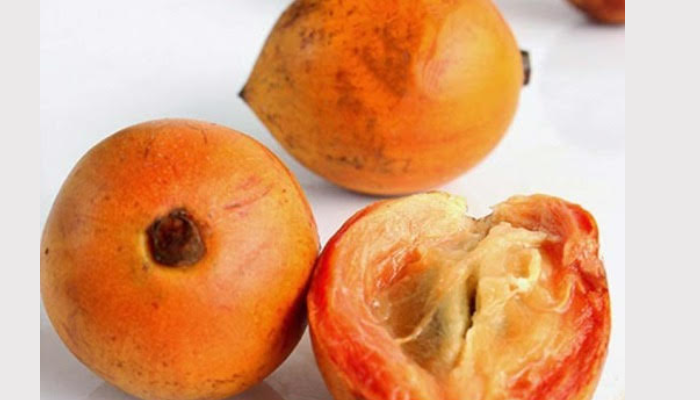
Agbalumo in the Yoruba language, Udara/Udala in the Ibo language and Siwoh in the Hausa language all refer to this tropical orange colored fruit that is very peculiar to Nigeria. It is known as Africa Star Apple or White Star Apple, although many local people in villages call this fruit simply cherry.
Commonly eaten as a snack, its soft, sweet inner flesh is off-white and contains seeds that form the inner pulp to resemble a star-shaped fruit.
This certainly explains where it got its name 'Star Apple'.
This vitamin C-rich fruit is always in season, between December and April and, sometimes, into part of May.
This colorful fruit with semicircular seeds is usually green when unripe, but when ripe, its color can lean toward orange or yellow – peach, or even burnt orange.
The 5-celled seedy fruit, which is edible, sweet, is a popular seasonal fruit that is usually eaten with the pulp.
Botanically known as Chrysophyllum albidum, this fruit is mostly cultivated in rural areas.
In many parts of West Africa, this pulpy fruit is commonly found and well known and its exotic fruit has a chewable edible skin.
From Nigeria to other African countries like Cameroon, Côte d'Ivoire, Uganda and Niger Republic, the story is virtually the same.
In South Western Nigeria, the name is Agbalumo, in South Eastern Nigeria, the name is either Udara or Udala and in much of Northern Nigeria, the name is Sivo, Sivoh or Agbaluma.
However, it is important to note that the abundant sale of this fruit has become a source of income for many rural and urban residents, mostly fruit traders, farmers and small and medium scale agricultural entrepreneurs.
Also read: African Star Apple – telling the story of African, Nigerian food
Health Benefits and Nutritional Value
• It is rich in Vitamin C. Its vitamin C is “a powerful antioxidant that can neutralize free radicals due to its antioxidant properties.”
• This pulpy fruit contains more Vitamin C than orange and guava.
• Udara is also rich in calcium, iron, potassium, phosphorus, magnesium, tannins, flavonoids, terpenoids and phytochemicals.
• When eaten with its flesh, it can help reduce blood sugar and cholesterol in the body.
• Consuming plenty of African star apples may help prevent and treat heart disease, fight cancer, and treat diabetes.
• Vitamin C aids the skin's natural regeneration process, which helps the body repair damaged skin cells.
• A recent study conducted by researchers at the Department of Biological Sciences, College of Science and Technology, Covenant University Ogun State, Nigeria, showed that the fruit helps reduce blood sugar and cholesterol.
• Medicinally, it is a good remedy for sore throat and toothache.
• It may be useful for constipation and in the prevention and treatment of heart diseases.
• The fruit is good for pregnant women, as the acidic taste of the fruit usually helps prevent the urge to vomit during pregnancy. The fruit has a sour taste which strengthens the palate of the mouth and helps in excessive spitting up and vomiting.
• The bark of the tree can be used traditionally to treat yellow fever and malaria, while the leaves can be used to treat wounds, stomach aches and diarrhea.
• Agbalumo can be a natural remedy for toothache, constipation and sore throat.
• In parts of Africa, Nigeria, the seeds can be used to treat vaginal and skin infections.
• Fruit is a good source of calcium, with each serving providing about 10 percent of the daily requirement. This is essential because calcium strengthens bones and teeth.
• Eating fruit may help reduce symptoms of premenstrual syndrome, such as cramps and abdominal bloating.
• This fruit also contains 5 percent of the daily recommended value of vitamin A per serving.
So, visit your nearest fruit market and enjoy the uniqueness of the fruit.
