
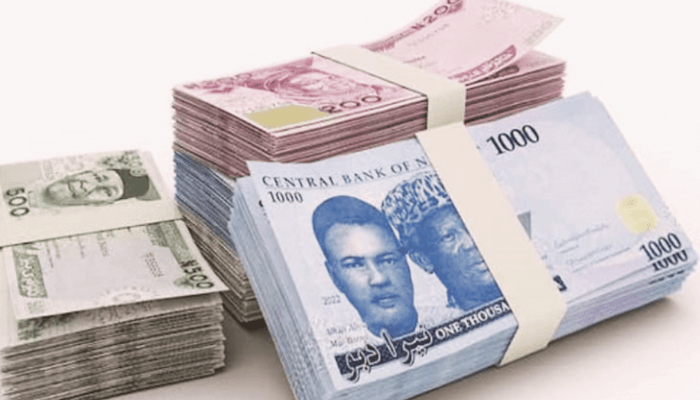
The Naira gap, the spread between the official foreign exchange (FX) market and the parallel market, narrowed to N65 on Friday as bureau de change (BDC) operators prepared to access fresh dollar supply from banks this week after the Central Bank reopened the FX market for retail trading.
The spread declined by 4.6 per cent from N92 on Wednesday to N65 on Friday, reflecting renewed convergence between the two markets. Data published by the Central Bank of Nigeria (CBN) showed that the Naira declined marginally for the second time this week, slipping to N1.76 as the dollar was quoted at N1,355.42 on Friday, a loss of 0.13 per cent compared to N1,353.66 recorded on Thursday at the Nigerian Foreign Exchange Market (NFEM).
However, according to CBN data, on a week-on-week basis, the naira rose by N10.77 per dollar to close at N1,355.42 on Friday compared to N1,366.19 in the same market a week ago.
In five trading sessions, the local currency strengthened marginally to N1.16 from N1,354.26 quoted on Monday in the NFEM.
At the parallel market, the Naira gained further by N10 with the dollar being quoted at N1,420, representing a gain of 0.7 per cent compared to N1,430 traded on Thursday.
According to the Financial Market Dealers Association, the naira appreciated by an average of 2.47 percent in January 2026. “The Naira traded in the N1,300 per dollar range in January, its strongest level since the second quarter of 2024. Crude oil prices ended the month above $70 a barrel, reaching its highest level since September 2025. The Naira's performance was supported by stronger oil prices and ultimately a softer US dollar.” January,” FMDA analysts said.
Also Read Here's why businesses lose contracts due to avoidable TCC filing errors
Nigeria's external reserves have steadily increased, rising to $47.53 billion as of February 10, 2026, according to CBN data.
Notably, the convergence trend began even before BDCs received actual dollar allocations from the Nigerian foreign exchange market, suggesting that the policy signal alone influenced pricing expectations and reduced speculative positioning.
President of the Association of Bureau de Change Operators of Nigeria (ABCON), Aminu Gwadabe, said the initial narrowing of the spread reflected market confidence in the communication strategy of the apex bank.
“This is the power of CBN’s forward communication and it is working perfectly,” Gwadabe said. He said BDC operators have started approaching their banks to understand the operational modalities and framework for accessing the dollar. “We hope to begin widespread operations before the end of the week,” he said.
In a circular dated February 10, the CBN said all duly licensed BDCs are allowed to purchase foreign currency from the Nigerian foreign exchange market through any authorized dealer bank of their choice at prevailing market rates.
The move follows the apex bank's confirmation in September 2025 that 82 BDC operators were fully licensed under its revised regulatory framework, with operations beginning on November 27, 2025, as part of reforms aimed at formalizing retail forex supply.
Under the new framework, authorized dealer banks are required to conduct full know-your-customer checks and due diligence on BDC customers in line with regulatory standards and internal risk management requirements. Upon completion, banks can sell foreign currency to BDCs for eligible retail transactions, subject to a weekly limit of $150,000 per bureau.
Commenting on the development, Charlie Robertson, author of The Time Traveling Economist, said the measure would help reduce distortions in the currency market.
Gwadabe described the clarification allowing BDCs access to the NFEM window through deposit money banks as highly commendable, adding that it reflects the CBN's commitment to financial inclusion and liquidity at the retail end of the market.
According to him, the circular will have a positive impact on exchange rate stability, reduce the persistent premium between official and unregulated markets and improve price discovery. He said increasing access to official supply will curb speculative activities and promote transparency and accountability in the forex ecosystem.
He said the policy change is expected to enhance investor confidence in the sub-sector and the broader financial industry while strengthening the role of BDCs in the CBN's foreign exchange transmission mechanism.
He also urged members to ensure strict compliance with prudential guidelines and anti-money laundering and counter-terrorism financing obligations when official supplies resume.
Meanwhile, Nigeria's external reserves continued to climb to $47.53 billion by February 10, 2026, strengthening the CBN's ability to maintain interventions in the retail FX market and support ongoing exchange rate convergence.

