
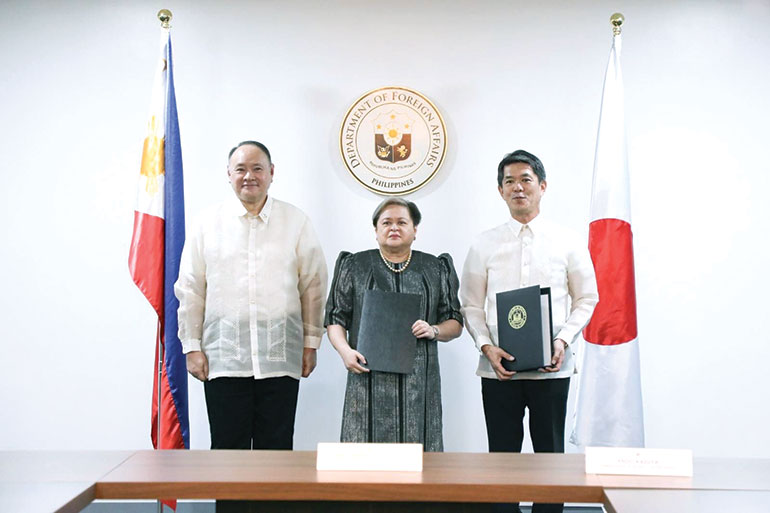
Beginning in post-war reconciliation and strengthened through decades of economic cooperation, political dialogue and people-to-people exchanges, the relationship between Japan and the Philippines is one of the most enduring and strategically important partnerships in Southeast Asia.
In recent years, changing geopolitical realities, economic restructuring and regional security challenges have led both countries to deepen cooperation in the economic, diplomatic and defense sectors.
This convergence underlines not only shared interests but also a collective vision for a stable, rules-based Indo-Pacific order.
Historical foundations and diplomatic development
Formal diplomatic relations between the Philippines and Japan were re-established in 1956 following the signing of a peace treaty and indemnity agreement, which laid the ground for reconciliation and long-term cooperation. Since then, bilateral engagement has been characterized by confidence-building measures, high-level political dialogue and strong development assistance.
Japan's continued commitment to the post-war reconstruction and modernization of the Philippines established Tokyo as Manila's most reliable development partner, a position it maintains.
Over the decades, the relationship has matured from aid-based cooperation to a strategic partnership based on mutual economic development, political alignment and shared democratic values.
High-level exchanges have become institutionalized through bilateral mechanisms such as the Philippines-Japan High-level Joint Committee on Infrastructure Development and Economic Cooperation, which regularly reviews development priorities and strategic initiatives.
Recent dialogues reaffirmed Japan's role as the Philippines' largest source of official development assistance (ODA), particularly in infrastructure, disaster risk reduction and inclusive development programs.
economic integration and trade
Economic cooperation is the backbone of Japan–Philippines relations. An important milestone was the signing of the Japan–Philippines Economic Partnership Agreement (JPEPA) in 2006, which came into force in 2008.
As the Philippines' first bilateral free trade agreement, the JPEPA liberalized trade in goods and services, strengthened investment flows, enhanced labor mobility, and improved the regulatory framework.
Japan remains one of the Philippines' top trading partners and sources of foreign direct investment. Thousands of Japanese companies operate in key sectors including manufacturing, electronics, automotive, agribusiness, information technology and renewable energy.
These investments not only create jobs but also support technology transfer, workforce development and industrial upgrading, thereby strengthening the Philippines' role in regional value chains.
Recent economic initiatives reflect a strategic realignment toward flexibility and supply-chain diversification. Joint infrastructure investments, including railways, ports and logistics corridors, are designed to enhance connectivity and trade efficiency.
The development of the Luzon Economic Corridor, supported by Japan, the Philippines and the United States (US), reflects this shift in manufacturing and mineral processing, particularly nickel for battery technologies.
Infrastructure development and official development assistance
Japan's ODA has been instrumental in improving the infrastructure landscape of the Philippines. Major major projects such as the North-South Commuter Railway, the Metro Manila Subway, and the regional airport modernization initiative highlight Japan's long-term investment in the country's physical connectivity.
Beyond transportation, Japanese assistance extends to flood control systems, climate resilience, and health care development.
In conflict-affected Mindanao, Japan has played a leading role in peacebuilding and socioeconomic rehabilitation, supporting livelihood programs, and institutional capacity building in the Bangsamoro Autonomous Region.
This multidimensional engagement reflects Japan's comprehensive “human security” approach, which emphasizes people-centered development and social resilience.
security convergence
In response to rising geopolitical tensions in the Indo-Pacific, Japan and the Philippines have intensified defense and security cooperation. Central to this transformation is the signing of the Reciprocal Access Agreement (RAA) in July 2024, Japan's first defense agreement with a Southeast Asian country.
The RAA complements existing trilateral cooperation involving the United States and reflects shared concerns on maritime security and the rule of law in disputed waters.
Recent defense agreements, including acquisitions and cross-servicing agreements, enable military cooperation and operational readiness, particularly in humanitarian and disaster-relief missions.
Japan's provision of funding for maritime surveillance equipment, patrol vessels and security infrastructure strengthens the Philippines' ability to protect its exclusive economic zone.
These measures, while defensive in nature, signal growing strategic alignment aimed at maintaining regional stability amid rising tensions in the South China Sea.

People-to-people exchanges and cultural contacts
There are currently more than 340,000 Filipinos living in Japan, making significant contributions in sectors such as health care, construction, agriculture and manufacturing. The labor mobility arrangement under JPEPA has facilitated the deployment of Filipino nurses and caregivers, addressing the demographic challenges in Japan's aging society.
Tourism has also boomed, with more than 800,000 Filipinos visiting Japan in 2024, a record high. Cultural diplomacy, spanning education, sports, creative industries and language training, has deepened mutual understanding and social intimacy.
These interactions foster diplomatic goodwill and a grassroots foundation for economic cooperation that strengthens long-term bilateral resilience.
Trilateral and regional engagement
Beyond bilateral cooperation, Japan and the Philippines cooperate within a broad multilateral and minilateral framework. Trilateral coordination with the US enhances maritime security, disaster preparedness, and infrastructure financing.
Meanwhile, exploratory dialogues involving India indicate emerging opportunities for expanded regional partnerships that link economic growth with strategic stability.
Such multilateral engagements reflect a shared commitment to the rules-based international system, open markets and sustainable development. By situating their partnership within a larger regional framework, Japan and the Philippines enhance their collective diplomatic influence and economic leverage.
what lies ahead
Amid strong progress, challenges remain. Economic disparities, gaps in infrastructure financing, regulatory complexity and workforce skills mismatch require continued policy alignment and institutional reforms.
Furthermore, intensifying geopolitical competition in the Indo-Pacific requires careful diplomatic calibration to balance strategic interests while maintaining regional stability.
Nevertheless, the long-term outlook remains optimistic. Japan's continued investment in infrastructure, technology transfer, and human capital development positions the Philippines as a strategic hub in Southeast Asia. Concurrently, the Philippines' economic dynamism, demographic dividend and reform agenda render Japan a reliable partner for diversification and regional engagement.
The growing Japan–Philippines partnership exemplifies a comprehensive model of economic integration and diplomatic cooperation. Rooted in historical rapprochement, driven by economic interdependence and strengthened by strategic convergence, bilateral relations continue to expand in depth and complexity.
As regional uncertainties increase, the partnership provides a stabilizing force rooted in shared values, mutual respect and forward-looking cooperation. Dealing with the opportunities and challenges of the 21stscheduled tribe-In the Indo-Pacific, Japan and the Philippines are ready to shape a partnership that not only advances national interests but also contributes meaningfully to regional peace, prosperity and resilience. — Crystal Angela H Gamboa