

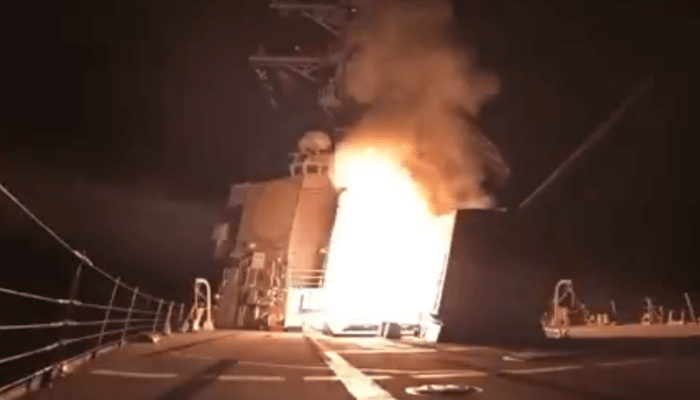
On the night of December 25, the United States launched targeted missile strikes against ISIS militants in the Jabo community in Sokoto State, fulfilling President Donald Trump's threat to attack terrorist camps in the country on November 1. The number of casualties is not known at this time, but Trump confirmed in his social media post that the strikes were 'proper'. More such attacks are expected to begin in other parts of northern Nigeria in the coming weeks and months. The Tomahawk missile, launched from a warship in the Gulf of Guinea, probably covered a range of more than 1,600 kilometers. It is a perfect Christmas gift for the long suffering Nigerians who have been victims of terrorism for decades. The action came nearly two months after the US President issued a threat on November 1 to attack militant hideouts in northern Nigeria if Nigeria did not take steps to tackle insecurity.
Since then, Nigeria and the US have engaged in intensive diplomatic contacts to agree on the modalities of military operations. The US War Department, AFRICOM, and the Nigerian Foreign Ministry have both said that the attacks were carried out in cooperation between Nigeria and the US. In preparation for these attacks, the US has been conducting surveillance flights over Nigeria from Accra, Ghana since late November. The flights are part of a broader effort to gather intelligence on terrorist groups including Boko Haram and ISWAP (Islamic State of West Africa Province). Many Nigerians are pleased that President Trump has fulfilled his promise to intervene and assist Nigeria in fighting terrorism.
Speaking to the BBC on Friday morning, Nigeria's Foreign Minister Yusuf Tuggar insisted that President Bola Tinubu had given the green light to the US attacks. The minister said, “Now that the US is cooperating, we will do it jointly, and we will ensure, as the President stressed before giving the green signal yesterday, that it should be made clear that this is a joint operation, and it is not targeting any religion and not just in the name of one religion or the other.” The Nigerian side's emphasis on the word “cooperation” is aimed at appeasing the northerners who have been categorically opposed to any US action, even though they have been bearing the brunt of terrorist attacks for nearly two decades.
But if it's such a collaborative effort, why aren't we hearing directly from the Nigerian President? In such a joint military operation, both commanders-in-chief must be visible and connect directly with their respective citizens. But while Tinubu is silent on this matter, Trump is speaking directly to the world. As soon as the missiles were fired, they immediately declared an attack. This should be a humbling moment for the Nigerian leader. For over 16 years, the government has failed to protect Nigerians from terrorists. Many people have been murdered as terrorists attack from one part of the country to another and kill innocent people. The Tinubu administration has appeared particularly inflexible in handling the security crisis. The capture and killing of General Musa Uba, commander of 25 Task Force Brigade in Damboa, Borno State, on 14 November, when his convoy was ambushed by terrorists on the Burum-Kubua axis of the Damboa-Biyu road, is an example of how bad the situation has become. This is the first time that such a high-ranking officer was ambushed, captured and killed during an operation, giving rise to speculations that there were saboteurs within the armed forces.
Even with the deteriorating security situation, there was a general perception that the administration was more obsessed with 2027 politics than governance. Nigerians were particularly enraged by the actions of praise singers such as Femi Fani-Kayode and Reno Omokari, who tried to create the impression that everything was fine. The National Assembly, which should have shifted the focus of administration from politics to security, has been much more lenient and flexible. The leadership of both Houses is more interested in praising the executive rather than holding it accountable. These missile attacks in Sokoto, and those to be launched in other northern states, are a positive development in the war against terrorism that the Nigerian Army has been fighting for years.
Although the military action is said to be a collaborative effort between the US and Nigeria, there is no doubt that the US is in the driver's seat here. When President Trump first issued his threats on November 1, it was strongly criticized by many ignorant commentators and TV analysts. He claimed that the US was out to violate Nigeria's sovereignty and possibly remove Tinubu from office. President Trump's repeated use of the phrase “Christian genocide” angered many politicians and Northern elites, who argued that Muslims are also victims of terrorism. My argument then – and now – is that American intervention is vital to defeating terrorism. It was clear from two US Congressional hearings on the matter and visits by two US delegations from Washington, DC that Trump was serious. Many have wondered why the target of the attack is a village in Sokoto State and not Borno, which has been the epicenter of Boko Haram. The answer is simple. Since these strikes were preceded by numerous reconnaissance flights, it should be clear that the US gathered enough intelligence to determine the correct targets. Terrorists generally gather at places they consider safe havens and move towards their targets in large numbers. The US military knows what it is doing.
