
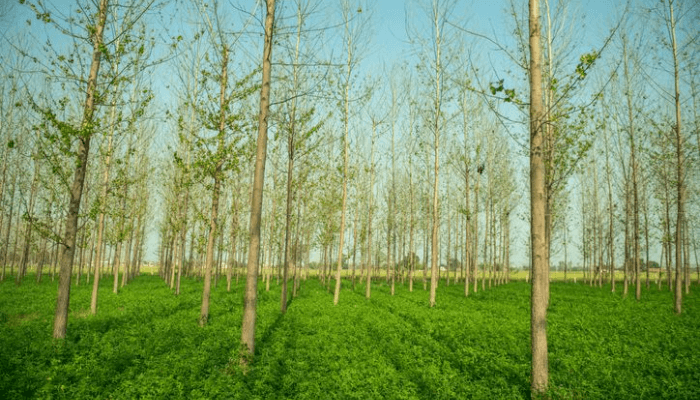
Farmers are often portrayed as victims of climate change. In fact, they are some of the most powerful actors in the fight against it. Across rural Nigeria, a peaceful transformation is underway, linking food production with forest restoration, livelihoods with climate action, and sustainability with profits. This approach is agroforestry, and it may well determine whether our reforestation ambitions succeed or fail.
Agroforestry is the intentional integration of trees into crop and livestock farming systems. This is not a new concept; Trees, crops, and animals have long coexisted in many traditional Nigerian agricultural practices. What is new is that agroforestry is now being reinvented as a climate, food security and economic strategy.
Forest cover in Nigeria is decreasing at an alarming rate due to logging, fuelwood harvesting, urbanization and, critically, agricultural expansion. At the same time, millions of small farmers are struggling with declining soil fertility, irregular rainfall, rising temperatures and declining yields. Any environmental solution that treats forests and farms as competing land uses is doomed to fail.
This is where agroforestry changes the story. Instead of asking communities to choose between farming and forests, it allows them to do both simultaneously and sustainably.
Well-designed agroforestry systems improve soil health through increased organic matter, nitrogen fixation, and reduced erosion. Trees provide shade that lowers soil temperatures and reduces moisture loss, making crops more resilient to heat stress and drought. Windbreaks protect fields from extreme weather, while tree roots stabilize the soil and reduce the risk of flooding.
From a climate perspective, agroforestry sequesters carbon both above and below ground. From an economic point of view, it diversifies income. Farmers can harvest fruits, nuts, wood, fodder, resins and medicinal products along with their main crops. In volatile economic times, this diversification is not a luxury; It is a survival strategy.
Across Nigeria, practical examples are already emerging. Cocoa agroforestry systems in the southwest are integrating shade trees that improve yields while restoring degraded landscapes. In the middle belt, farmers are combining nitrogen-fixing trees with maize and cassava to revitalize degraded soils. In parts of the North, shelterbelt and parkland systems are helping communities combat desertification while maintaining food production.
Yet, despite its promise, agroforestry is underutilized in mainstream climate and reforestation programs. Many tree-planting initiatives focus on hectares planted rather than improved lives. Plants are distributed without long-term management plans, the realities of land ownership are ignored, and communities are treated as beneficiaries rather than partners. The result is predictable: high seedling mortality, community resistance, and projects that look impressive on paper but have little lasting impact on the ground.
This leads us to an uncomfortable but necessary truth: reforestation and environmental sustainability projects will fail if food sustainability and community impacts are neglected.
Communities cannot be expected to protect forests if doing so jeopardizes their ability to support their families. Asking farmers to give up productive land for plantations, without providing viable livelihood options, creates a direct conflict between environmental goals and human survival. In such contexts, forests will always suffer losses.
Agroforestry resolves this conflict by aligning incentives. When trees contribute directly to household income and food security, farmers have a vested interest in their survival. Environmental management becomes economically rational, not externally imposed.
For policymakers and corporate actors investing in ESG, this has important implications. Social and environmental goals cannot be achieved in silos. A climate project that reduces emissions but increases food insecurity is not sustainable. Similarly, a reforestation program that excludes local communities from design, ownership and benefits is unlikely to be sustainable.
Nigeria’s ESG journey, especially under rising expectations of global sustainability standards, demands more integrated thinking. Climate mitigation, adaptation, food systems, livelihoods and biodiversity must be addressed simultaneously. Agroforestry offers a rare opportunity to do just that.
To scale up agroforestry effectively, three things are important. First, enabling policies that recognize and support tree-based agricultural systems, including land tenure security for smallholder farmers. Second, access to finance and technical assistance tailored to the long-term returns of agroforestry rather than short-term yield cycles. Third, genuine community engagement, not as an afterthought, but as the foundation of project design.
For the private sector, agroforestry also presents an attractive ESG opportunity. Companies can support resilient supply chains, reduce Scope 3 emissions, enhance biodiversity and deliver measurable social impact while strengthening relationships with farming communities. Well done, this is ESG about integrity, not optics.
As Nigeria races to address climate change and environmental degradation, we must resist the temptation of simplistic solutions. Planting trees is not enough. Protecting forests is not enough. Sustainability that ignores people, food and livelihoods is not sustainable at all.
Agroforestry reminds us of a fundamental principle: the future of our forests is inseparable from the future of our farmers. If we get this right, rural communities will not only survive climate change; He will lead it.
Sarah Esangbedo Ajoze-Adeogun is the Founder and Managing Partner of Tisu Consulting. He is a former Community Materials Manager at Shell Petroleum Development Company and has served as Special Adviser on Strategy, Policy, Projects and Performance Management to the Edo State Government. She is also the host of the #SarahSpeaks podcast on YouTube @WinningBigWithSarah, where she shares insights on leadership, strategy, and sustainable development.
