
By abdurrahman And xiangguo huang, senior economist
For decades, the middle-income trap was viewed as a slow-moving structural dilemma. Economies grew rapidly by mobilizing labor and capital, then slowed as easy productivity gains faded and reforms stalled – leaving many countries stuck between rising wages and limited productivity growth.
Today, this framing is no longer sufficient. The global economy is now being shaped by recurring shocks, geopolitical fragmentation, and rapid technological change. For middle-income economies in the ASEAN+3 region, climbing the high-income ladder is possible, but the window is narrower and closing faster than before..
uneven convergence
The fundamentals of development in ASEAN+3 remain broadly strong. Macroeconomic frameworks have strengthened, inflation has been better controlled, and many economies have maintained adequate fiscal and monetary policy space. However, behind these positive indicators lies a large and persistent productivity gap compared to global frontier economies.
In some middle-income economies such as Indonesia and Thailand, manufacturing productivity has stagnated since the global financial crisis, while the services sector – which now employs the majority of workers – is struggling to upgrade. China's experience is the opposite. Its sustained growth in per capita GDP reflects decades of structural transformation, industrial progress and a persistent emphasis on productivity-driven competitiveness. These factors have brought China closer to achieving high-income status than many of its regional peers.
There are clear lessons within and beyond the region. Korea overcame the middle-income trap through strong macroeconomic discipline, export-driven industrial upgrading, and substantial investment in skills and technological infrastructure. On the other hand, several Latin American economies, including Brazil and Mexico, occasionally achieved economic stability but struggled to implement lasting productivity-enhancing reforms. As a result, manufacturing stagnated, services absorbed more workers without becoming more efficient, and growth became dependent on domestic demand and the credit cycle rather than global competition.
The implications are clear. Economic growth and employment may advance, but without productivity gains, income convergence will remain elusive. Manufacturing that fails to incorporate technological advances may reach stagnation, while service-sector expansion without digitalization and skill upgrading becomes unproductive.
In this environment, merely accelerating development is insufficient. The priority must shift towards sustainable, high-quality growth – driven by productivity, underpinned by inclusivity and secured by economic resilience.
AI, Productivity and Growth in ASEAN+3
What sets today's world apart is the speed of technological change. Unlike previous waves of industrial catch-up, which were largely driven by proliferation, AartifiSocial Intelligence (AI) is increasingly rewarding early movers and strong ecosystems. Companies and countries with advanced digital infrastructure, abundant data, deep talent pools and large markets have a productivity advantage.
This is a challenge for ASEAN+3, where development has traditionally depended on diffusion – through learning by doing, technology transfer through trade and investment, and continuously moving along value chains. If diffusion slows, or if emerging technologies intensify the “winner-maximizer” effect, productivity leaders could move even further – especially in economies with small domestic markets and weak innovation networks.
AI is already transforming productivity not only across sectors, but also within them. Companies with strong data resources, digital systems and skilled employees are using AI to reorganize production, streamline logistics and pursue higher value-added activities. Smaller companies, especially in traditional services, are at increasing risk of being left behind.
This growing gap between companies, workers, and regions could increase inequality, strain social cohesion, and reduce political support for the long-term reforms needed to sustain growth.
Policy priorities for high-quality development
Avoiding the middle-income trap will require a renewed effort to boost productivity through timely structural reforms. Key priorities include reducing entry barriers, improving firm resource allocation, and strengthening competitive edge.
It is equally important to improve infrastructure governance so that investments translate into productivity gains rather than merely expanding the balance sheet. Investing in human capital is important, as skills shortages and limited adaptability have become binding constraints in many middle-income economies. Coordinated reform efforts, particularly within ASEAN, could amplify these benefits.
Technology policy will also have to be adapted. AI should be treated as a general-purpose technology rather than a specific field. Promoting adoption, especially among small and medium-sized enterprises, is as important as promoting frontier innovation. Without targeted interventions, AI risks reinforcing dual economies, where a select group of highly productive leaders coexist with large numbers of low-productivity firms, increasing inequality and informal market pressures.
Ultimately, even strong domestic reforms may not be enough. The development landscape is increasingly shaped by international rules, standards and networks – from digital trade and data governance to climate finance and resilient supply chains. Therefore, regional and global cooperation is becoming more important.
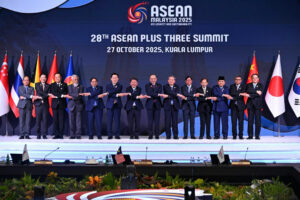
ASEAN+3 is well placed to respond. Deeper regional integration can help economies overcome barriers of scale, share technological progress, and maintain income convergence.
AI and global fragmentation are reshaping the path to development. For ASEAN+3, maintaining income convergence will depend on productivity-driven reforms, effective use of policy space, and deeper regional cooperation. Escaping the middle-income trap is no longer a slow, incremental process – it is a high-risk race against a rapidly moving ceiling. In an era defined by AI-driven disruption and increasing global fragmentation, inaction is not an option.
Dr. Abdurrahman is the Deputy Director (Operational Monitoring and Research) of the ASEAN+3 Macroeconomic Research Office or AMRO. Jianguo Huang is a Senior Economist at AMRO.