
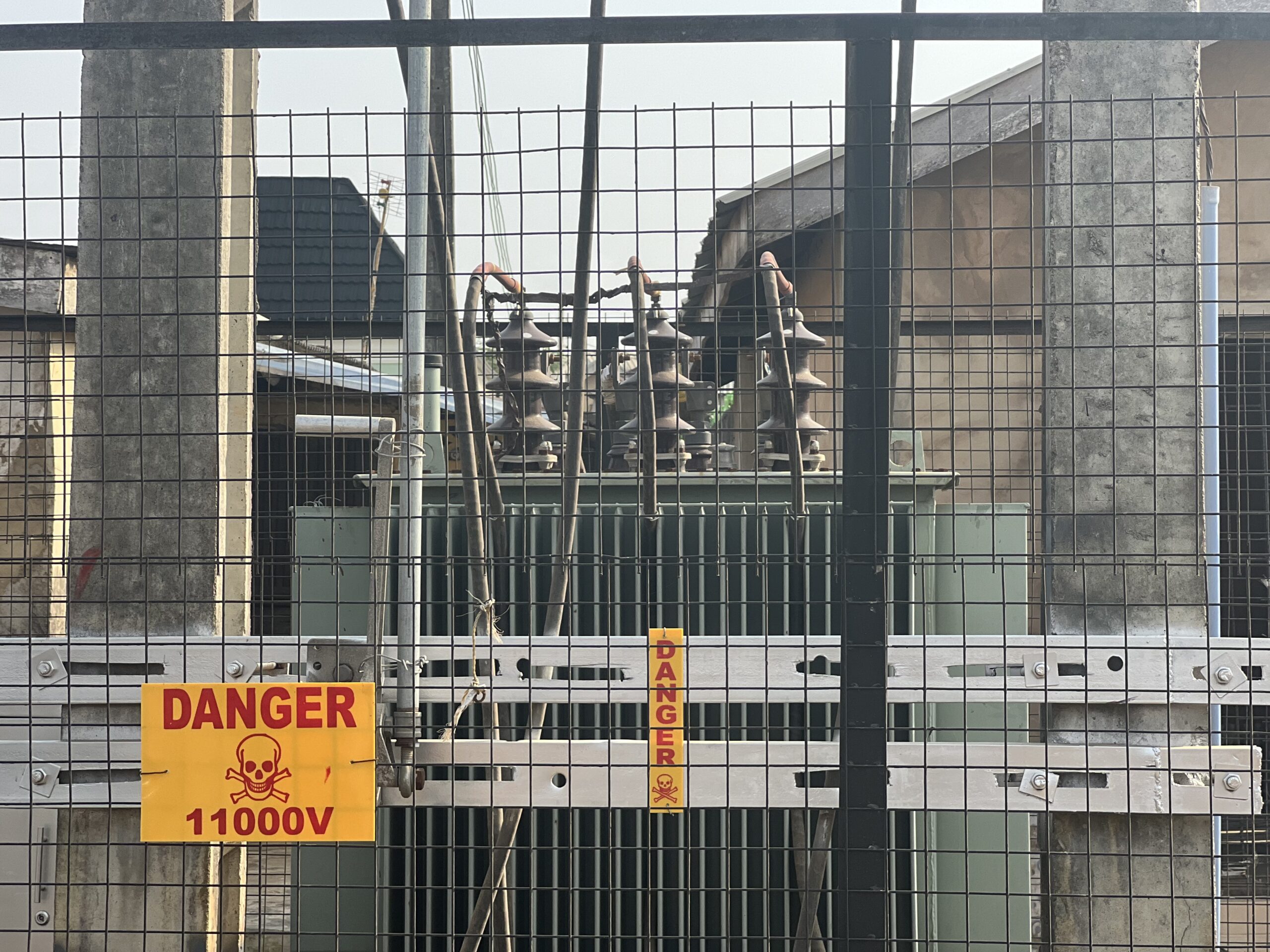
Unused transformer purchased five years ago. Photo Credit: Taofeek Oyedokun
At Oko Filling in the Igando area of Lagos State, a silent transformer stands as a symbol of both hope and despair.
The equipment, purchased in 2020 through communal contribution, was aimed at ending almost two decades of irregular power supply to thousands of residents of Alimosho Local Government Area. But five years later, the transformer remains unused, while homes and businesses continue to rely on the old, overloaded unit, which is prone to frequent breakdowns.
For residents, the irony is painful: They bought their own solution, yet remain stuck in the dark.
A community forced to help itself
For years, residents under the Ultimate Community Development Association (CDA) had requested the Ikeja Electricity Distribution Company (IKEDC) to provide a new transformer to ease the pressure on the existing transformer, which has been in use for about two decades. When those appeals yielded no results, the community took matters into their own hands.

Chairman of the CDA operated by 11-IGANDOINJ-T1-New Igando Feeder, Lawal Suleiman, said the decision was driven by frustration. “It's 2026, and the transformers we're managing are about 20 years old and badly overloaded,” he told BusinessDay. “That's why we decided to help ourselves and buy a relief transformer.”
Residents raised funds, purchased the transformer, and completed the installation, believing that IKEDC would activate it once regulatory processes were completed. Instead, the equipment has been lying idle for five years due to administrative and technical hurdles.
Suleman said the community has written letters, visited IKEDC offices and repeatedly contacted officials, but there has been no solution.
He said, “We have met all the requirements on our part. The only outstanding issue is the transformer meter of Ikeja Electric. Once the meter is available, the Nigerian Electricity Management Services Agency (NEMSA) will inspect it and the transformer can be energized.”

Meanwhile, residents face prolonged power outages, sometimes going without power for several weeks as aging transformers break down due to excessive load.
Businesses collapse under incredible power
For small business owners, unreliable power has turned into economic hardship and, in many cases, closure.
Nike Babatunde, who once ran a beverage business, said the rising cost of generators forced him to close it down. “I stopped selling beverages because I could no longer afford to refuel my generator, especially after the fuel subsidy was removed,” she told BusinessDay. “Customers want a cold drink, but the power supply here is very unreliable.”
Frozen food trader Chioma Emmanuel suffered a similar fate. “The cost of running a generator to power my freezer exceeds my profits,” he said. “When I added extra cost to my items, customers stopped buying and chose to go elsewhere.”

Even basic livelihoods have been disrupted. A dry cleaner in the community, speaking anonymously, said he now only goes to the neighboring area to iron clothes. “I go to another community to do ironing because I can't afford to run my generator every day,” he said.
Residents paid bills despite poor supply
Despite irregular electricity supply, many residents, most of whom do not have prepaid meters, continue to receive monthly estimated bills.
“They are happy when you don't have prepaid meters,” alleged a community leader. “Whether there is light or not, they still bring the bill.”

Residents also have to bear the cost of repairing cables damaged due to overloads from old transformers, further adding to the financial stress.
For nursing mothers like Wunmi Afolabi, the unused transformer has become a daily reminder of unfulfilled promises.
“It is sad to see transformers in our community and still suffer without electricity, especially during this period of extreme heat,” he lamented. “Government should compel Ikeja Electric to do the needful and activate it.”
Also read: Mixed reactions to FG directive on free prepaid electricity meters
What does the law say
Under Section 68 of the Electricity Act 2023, electricity distribution companies have been authorized to “expand distribution networks in licensed areas”.
This provision places the responsibility on DISCOs like IKEDC to create and upgrade infrastructure, including transformers, to ensure reliable power supply.
The law also clarifies that customer-funded infrastructure is optional, not mandatory, stating that such contributions “are outside consumers' general obligations.”
Regulatory provisions allow communities to finance transformers under specific circumstances, but require the distribution company to inspect, approve, and integrate the equipment into its network. Once integrated, the Disco takes over operational responsibility.
Although such arrangements are common due to infrastructure constraints and slow network expansion, distribution companies cannot indefinitely delay activating approved equipment without technical justification.
IKEDC cites procedural and contractor delays
Kingsley Okotie, Head of Corporate Communications at IKEDC, said energizing the transformer requires strict compliance with technical and regulatory standards.
“There are certain internal processes that need to be followed before a donated transformer can be accepted. If that process is not completed, it cannot be activated,” Okotie said in a telephone conversation with BusinessDay.
He stressed that security considerations are paramount. “This is electrical infrastructure. You don't ignore due diligence.”
Okotie said purchasing a transformer does not automatically make it eligible for integration into the network.
“Transformers are not something you pick off the shelf and say you've bought,” he said. “There are specifications. You can't buy anything without making sure it's fit for purpose.”
However, he acknowledged the long delay and said the company was reviewing the matter.
Providing a follow-up update, Okotie attributed the latest delay to pending construction work by a contractor.
“There are expectations from that contractor regarding the construction that needs to be done,” he said. “So that contractor hasn't come back. This is the latest update I've got so far.”
He explained that the contractor must meet specific requirements before regulatory inspections and final energization can proceed.
Stuck between lack of infrastructure and bureaucracy
For Ultimate CDA residents, the situation highlights a broader reality across Nigeria, where communities are increasingly self-funding critical electricity infrastructure due to slow expansion by distribution companies.
Yet, even after making such investments, many remain stuck in bureaucratic and technical entanglements.
For Dele Oyewale, the financial loss is huge. “Imagine relying on a generator for more than three weeks in a month and still being billed for electricity,” he said. “We contributed money to buy a new transformer, but even after five years it has not been connected.”
In Igando, the transformer still stands, disused, but not forgotten.
For residents, it represents much more than an electrical appliance. It symbolizes sacrifice, resilience and the long wait for power that has not yet come.
Until it gets energized, homes remain dependent on generators, businesses remain disrupted, and community-funded solutions to power shortages remain out of reach.

