
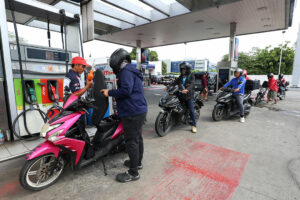

Energy Secretary Sharon S. Garin said Monday that a new batch of diesel orders totaling 900,000 barrels is due to arrive in the country next month.
At a virtual press briefing on Monday, Ms Garin said the Philippine government would receive 300,000 barrels from Malaysia and Singapore in early April, 300,000 barrels from India by the middle of the month and 300,000 barrels from Oman by the end of April.
The new supply is expected to boost the country's petroleum reserves, increasing the current average supply to about 50.94 days.
“Even though we know we have plenty of time to place orders or look for additional supplies, we would like to remind the public that we need to be very prudent because we do not know how long the war will last,” Ms. Garin said.
Department of Energy (DoE) monitoring showed that some oil companies are set to cut gasoline prices by as much as P2.35 per liter, while some fuel retailers may raise gasoline prices by as much as P2.90 per liter. Diesel prices will increase by P4.50-P12.90 per liter while kerosene prices will increase by P1-P2.40 per liter.
SeaOil Philippines, Inc. It will implement a one-time price increase of P12.50 per liter for diesel and P2 per liter for kerosene starting Tuesday morning. It will not adjust gasoline prices.
“For now, we are pausing further increases in gasoline prices to provide some relief to motorists,” the company said.
Unioil Petroleum Philippines, Inc. And PetroGaz will raise diesel prices by P12.50 per liter and gas prices by P2.50 per liter.
Petron Corp. will increase the price of gasoline by P1.90 per liter, diesel by P11.90 per liter and kerosene by P1.40 per liter, while Jetty Petroleum, Inc. It will increase the price of diesel by P12.90 per liter and gasoline by P1 per liter.
The latest price adjustment puts the brakes on double-digit increases for gasoline for the past three weeks. On the other hand, the prices of diesel and kerosene are continuously increasing.
The fuel price hike will bring current gasoline prices to about P115 per liter and diesel prices to P156 per liter in the National Capital Region.
The Philippines is a net importer of crude oil and most of its supplies come from the Middle East, making the country vulnerable to fluctuations in global crude oil prices.
To boost the country's oil buffer, the government plans to purchase two million barrels of oil with a budget allocation of P2 billion.
Last week, the Department of Energy (DOE) announced the arrival of the first shipment carrying 142,000 barrels of diesel, part of 1.04 million diesel secured by the government.
The Philippines is in a state of national energy emergency due to global fuel supply disruptions and rising oil prices. — Sheldin Joy Talavera