
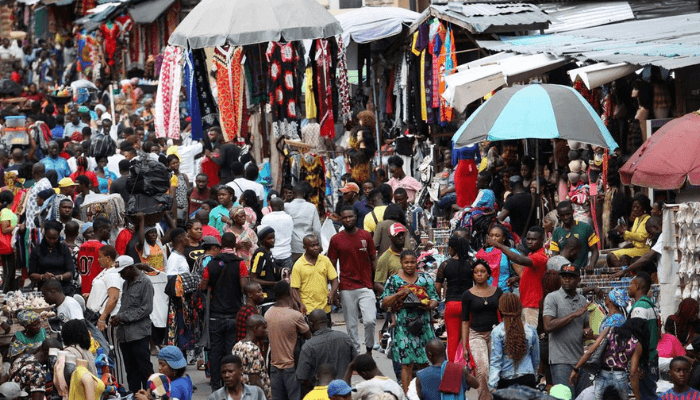
Does not scream when confronted. It gets resolved.
This becomes routine. It becomes language. It becomes how a country explains itself. With time, Nigerians stop describing failure as such. Failures become something you prepare for, budget for, and mentally prepare for.
Nigeria has not fallen. The fall will be honest. The collapse will force a reckoning. Nigeria has done something even more dangerous: it has become stagnant around a tension. The economy has learned how to operate just enough to avoid outrage, while taking far more from its people than it gives back.
“Nigeria's economy has grown by sacrifices that never appear in the national accounts – only in short tempers, deferred dreams and chronic exhaustion.”
A country that runs on the sacrifice of individuals
Every Nigerian family is an informal ministry.
They generate electricity, water, insure health, manage risk and absorb shocks. They pay twice – once in taxes, then in cost of living. What should be a public responsibility has been quietly reassigned as a personal responsibility.
And since it's done in private, it never counts.
No budget takes account of the hours lost due to traffic paralysis.
Neither GDP line reflects the cognitive fatigue of constant recalculation.
No national statistic measures how much the future costs to maintain today.
Nigeria's economy has grown by sacrifices that never appear in the national accounts – only in short tempers, dreams deferred and chronic exhaustion.
When adaptation becomes a cage
Coping teaches people how to escape broken systems, but it also teaches them not to expect anything better. Over time, the spec adjusts downwards. The horizons of planning are shrinking. Ambition becomes strategic.
In this way a nation gradually loses its sense of possibility. Not through despair – but through realism trained to remain alert.
Competing creates quiet class divisions
Competing is not equal. It never was. Those who have the means turn procrastination into inconvenience. Which without change turns it into degradation. Money doesn't just buy comfort – it also buys protection from failure. It buys time, predictability, comfort, and margin for error.
In Nigeria, wealth is not just about consumption.
It's about distance versus friction.
Also read: Economics of competition
The poor spend energy.
Rich people spend money.
The economy rewards the latter far more generously.
Inequality thus grows without fanfare – through cumulative disadvantage that accumulates silently in daily life.
Why do the hardest workers get the lowest returns?
The work here is heavy because the system does not increase it. Energy is spent on holding the ground rather than gaining altitude. People run sideways to stay upright. By the time the cost of living is paid, there is nothing left to compound.
That's why motion is everywhere, but speed is rare.
The tragedy is not laziness.
This is wasted effort.
when patience runs out
Countries like Nigeria do not fail dramatically. They continue quietly, mechanically, long after the costs exceed the benefits. The first thing that breaks is not the economy, but the people within it. What happens next is not rebellion, but retreat.
Endurance has limits, even if it seems endless.
Man absorbs pressure by compressing himself. They become more alert. More transactions. Less patient. Less generous. The emotional bandwidth necessary for trust, cooperation, and civic engagement gradually ceases to exist.
An economy can survive that. A nation cannot.
silent return
The most consequential response to procrastination is not protest.
This is disengagement.
Talented Nigerians don't always quit physically. Many people give up psychologically at first. They stop long term construction here. They end up investing more capital, time and imagination than necessary. They protect their lives. They stay one step away from every promise.
This is not skepticism.
This is self-preservation.
And this is devastating.
Because growth depends on people willing to bet here, not just survive.
when trust is lost
Trust is the least important economic asset.
This reduces transaction costs. This speeds up collaboration. This allows the system to scale. When trust is lost, everything becomes costly – emotional, financial, administrative.
In Nigeria, trust has gone downwards.
People trust individuals, not institutions. Network, not system. Personal guarantee, not public. This works – until scale is needed. Informality cannot create infrastructure. Reform cannot replace policy. Survival logic cannot provide national transformation.
What competition steals from the future
The heaviest burden will not be borne by today's workers.
It will be carried by people who have grown up within this generalized strain.
Children trained in constant adjustment learn to adapt to instability. They become smart, fast and adaptable – and profoundly avoid taking risks. They are taught how to avoid dysfunction, not how to redesign it.
Capacity quietly diminishes because the imagination becomes disciplined too quickly.
final illusion
The most dangerous lie is not that Nigerians are strong. The lie is that strength is enough.
A country that depends on resilience is living on borrowed human capital. Eventually, stamina becomes a liability. strength delay collapse; It doesn't stop it.
Nigeria does not need tough people.
It needs systems that stop demanding toughness as proof of citizenship.
Because an economy that runs on competition never reaches its potential – only its limits. And Nigeria is closer to that limit than it wants to admit.
slowly.
silent.
necessarily.
Emmanuel C. Macaulay is a development thinker and author who examines the unseen logic behind everyday realities – where leadership, systems and design shape collective progress.
