

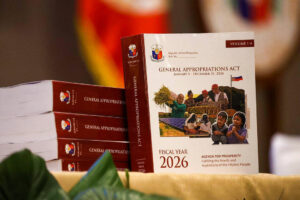

Following their concerns over P633 billion worth of projects at risk of corruption and patronage, multi-sector groups on Monday raised their recommendations on the bicameral-approved P6.793-trillion national budget for 2026.
“We recommend that the President take action on projects worth more than P633 billion at risk of corruption and patronage in the bicameral version of the budget,” the Roundtable for Inclusive Development (RFID) and the People's Budget Coalition (PBC) said in a joint statement.
Both houses of Congress separately ratified the bicameral conference committee report on the proposed national budget for 2026 on Monday.
The first recommendation filed by the groups highlights vetoing P243 billion worth of unprogrammed appropriations, also known as “shadow pork,” that were previously used to fund unregulated flood control projects, in addition to eliminating the P43 billion SAGIP program.
The groups define shadow pork as funds that are “outside the regular budget framework” and have often been used in “risky” infrastructure projects over the years due to their minimal transparency or legislative scrutiny upon release.
Citizen groups said, “The special provisions on unprogrammed appropriations violate specific provisions in the Supreme Court's PDAF decision.”
“The constitutionality of unprogrammed appropriations is an issue in itself, because Congress artificially inflates the budget limits set by the President as required under the Constitution; it also violates the separation of powers and the non-delegability of the legislative power of the purse,” he said.
The groups also promoted the transformation of P11 billion worth of Confidential and Intelligence Fund (CIF) as well as P210 billion worth of conservation-driven assistance or AYUDA into “rights-based and rules-based programs” in consultation with allied health professionals and social protection experts.
According to the groups, soft pork makes aid programs at risk of political patronage because it leads citizens to “beg” politicians for aid.
“Politicians should be kept out of the process of selection of beneficiaries, which is prevalent under the inhumane and unconstitutional letter of guarantee system that encourages post-enactment interference by legislators in the budget,” he said.
“We are concerned that the bicameral conference committee has increased the soft pork allowance almost three times to P210 billion compared to the President's proposed budget,” he said.
The final recommendation outlined included the inclusion of P600 billion worth of infrastructure projects under a multi-sector civilian monitoring initiative funded by government or internationally funded independent research programs.
The 2025 national budget faced public scrutiny after several budget allocations and Congress collusion were discovered, leading to several rallies across the country for transparency and accountability.
“As citizens, we are committed to working with you to oversee the budget process so that our country benefits every taxpayer,” he said. ,Buvis natin ito, budget natin ito [This is our taxes, this is our budget], Almira Louise S. Martinez