
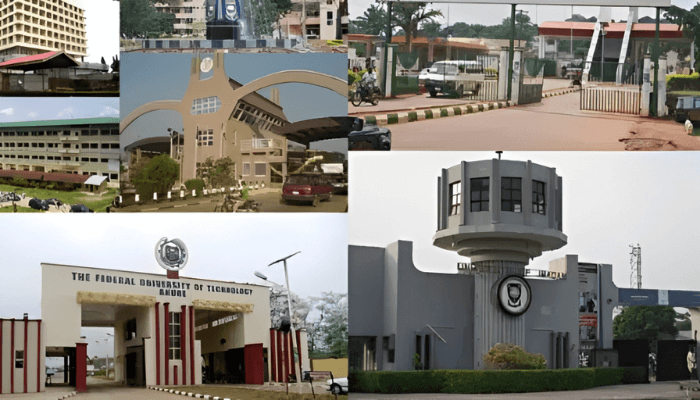
Nigeria's public universities suffer from falling academic standards, inadequate facilities and frequent disruptions. Yet, amid these challenges, concerns are growing over the extravagant lifestyles of some university administrators, sparking debate about governance and the real causes of the sector's crisis.
According to a report by SaharaReporters, a review of Nigeria's 2026 budget shows that the Michael Okpara University of Agriculture, Umudike, Abia State has earmarked N252 million for the purchase of three luxury vehicles for top officials.
These vehicles are for the Pro-Chancellor and two key officials of the university. According to reports, the university plans to spend an average of N84 million on each vehicle.
No less than N96 million was allocated by the institution for the completion and furnishing of the Chancellor's Lodge.
Additionally, another N21 million was set aside for the completion and furnishing of the Pro-Chancellor's Lodge.
The budget also makes provision for the installation of perimeter fencing of the university, which is estimated to cost N105 million in the 2026 financial year. The fencing project has been listed as part of the institute's capital expenditure for the year.
Similarly, the University of Nigeria, Nsukka (UNN) had spent a total of N773 million on honorary and other stipends during the 2024 financial year, according to a review of the financial statements of the institution for the year ending December 31, 2024.
The report further revealed that the university spent an additional N240 million on refreshments and meals within the period, taking the total expenditure on honorarium, stipends and refreshments to N1.013 billion in 2024.
Sadly, only 10.7 per cent (N83 million) of what was spent on honorarium (N773 million) during the same year was spent on direct teaching and laboratory costs.
Also read: How does inadequate hostel space in public universities trouble students?
Meanwhile, at the Michael Okpara University of Agriculture, other projects are also demanding attention. The university allocated N350 million for the construction of the 7.5 kilometer long Oloko-Amizie Road (Section II), located in Abia Central.
The project is included as part of the capital development plans of the university for 2026, and involves the sum of N210 million for the construction of Nkukunmiri Ala Ala-Okeuzo Oloko Road in Ikwuan Local Government Area of Abia State.
poor funding
Insufficient public funding remains a fundamental challenge for Nigerian universities. Government budgetary allocations to education consistently fall well below the UNESCO-recommended 26 percent, often around 7–8 percent, leading to long-term funding gaps in tertiary institutions.
Many public universities operate with dilapidated buildings, overcrowded lecture halls, and outdated or non-functional laboratories.
Practical exercises and experiential learning, especially in science, technology, engineering and medicine, are compromised due to lack of equipment.
In some cases, students watch demonstrations rather than gain practical experience, hindering skill acquisition.
Corruption in Nigeria's Ivory Towers
Studies have shown that public universities' funds for infrastructure, staff development, research, and student support are often mismanaged or misused, reducing resources available for core academic functions.
A SERAP report documented issues such as contract inflation, inaccurate results, employment of unqualified staff and selling of certificates in Nigerian tertiary institutions.
Friday Erhabor, director of media and strategies at Marklanes Limited, described the development as unfortunate
Erhabor stressed that it is regrettable that government-owned tertiary institutions lack integrity and accountability.
“They are demanding autonomy on the one hand and yet they lack transparency and accountability.
“Many public tertiary institutions have not had an audit report for more than five years. These are the people who are supposed to be role models,” he said.
He said the Academic Staff Association of Universities should lead the fight against corruption in the university system and not just talk about salary increases.
“Let them fight internal corruption within the university system,” he said.
Nigerian universities operate under severe financial constraints, with their education funding falling far short of international standards. Excessive spending on luxury vehicles, extravagant perks and lavish celebrations will divert scarce resources that would otherwise be used for teaching and learning infrastructure, research and innovation and student support services.
In an environment of scarcity, every penny spent on non-essential goods makes institutional decay worse.
