
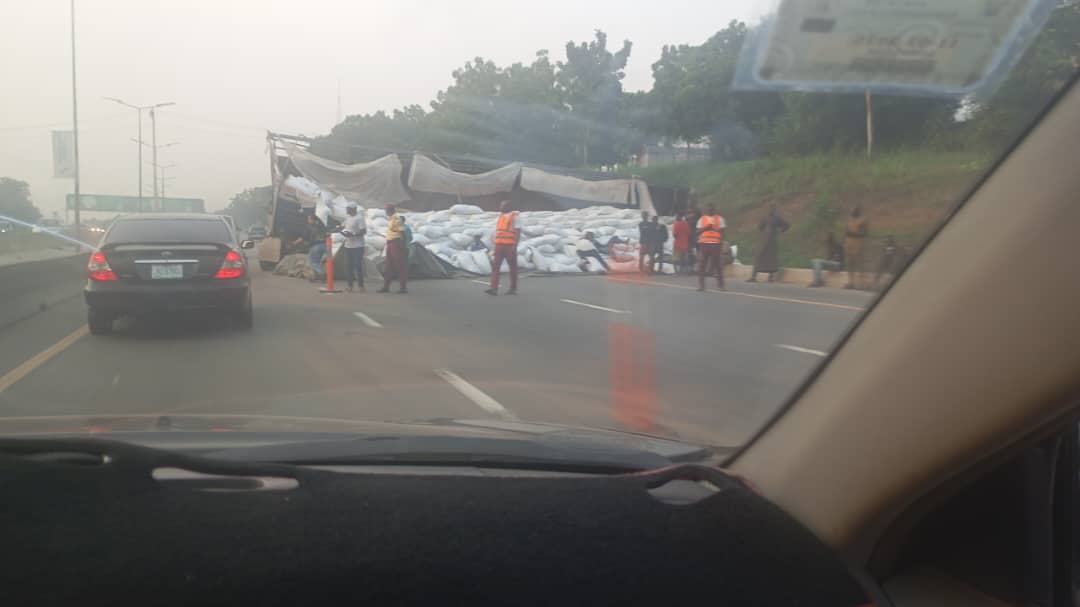
The prolonged traffic gridlock on the Lagos-Ibadan Expressway on Friday has once again exposed the fragility of the transport infrastructure.
The disruption occurred after two heavy-duty trucks collided near the Otedola Bridge area of Lagos, blocking most of the inner-city carriageway. One person died in the accident, while traffic was quickly disrupted for several kilometers, leaving passengers and commercial vehicles stranded for hours.
Officials said ongoing repair works on sections of the expressway, including maintenance of expansion joints on the Kara Bridge, have increased congestion by narrowing the lanes and slowing traffic flow at peak volumes. Traffic management agencies were deployed, but the incident exposed the limited shock absorbing capacity of Nigeria's busiest highway.
The gridlock, which mainly persisted around the Magboro-Alausa corridor of the expressway, forced motorists traveling from Mowe, Redemption Camp and Kara Bridge to Lagos to take alternative and already congested inner-city routes, increasing travel times and adding to commuters' frustrations.
hours spent in misery
The standoff that followed was unlike the usual morning crawl of Lagosians. It stretched from the Otedola Bridge to the Berger area, a stretch that would normally take minutes to cross, leaving commuters stranded for hours.
For many, the road turned into a slow-moving misery of blaring horns, stalled engines and human impatience.
Victoria, a passenger who spoke to PUNCH while stranded in the scorching heat at 11 am, said, “I have never seen anything like this in my life. I was stuck for more than five hours. Thank God it was not an explosion. If that had happened, many people would have lost their lives, there is no alternative way here.”
Diversion route. It was intended to ease pressure, but instead it became jammed with traffic as frustrated motorists sought any available way out. Some people abandoned their vehicles altogether and opted to walk long distances to reach bus stops or nearby towns. Motorcyclists, desperate to find a way around the obstruction, risked their lives by riding against the flow of traffic.
Parents and students stuck in confusion
The human cost was not limited to time lost. Those caught included parents trying to reach home or workplace and children returning from school. A mother, carrying a baby on her back and dragging a small child by the hand, was seen walking a painful way to the side of the road after she and her children were forced to leave a bus that served as a slow-moving incubator of heat and stress.
“At one point my child started vomiting; the child was crying continuously,” she said. “This is the worst traffic I've ever experienced.”
Children walked long distances in the scorching sun, some unable to keep pace with the flow of tired hikers. For working parents, the delays were more than an annoyance: They threatened livelihoods and daily routines in communities already struggling with rising costs of living.
Emergency response under investigation
Emergency responders, including police and traffic management workers, were eventually deployed to manage the change and ensure order. Still, people stuck in the jam felt the response was delayed.
“Help did not come on time,” lamented a passenger. “Once it went haywire, there was no quick intervention. It was chaos.”
The Federal Road Safety Corps (FRSC) confirmed that the congestion was aggravated by ongoing repair works on the Kara Bridge expansion joints, an infrastructure project intended to modernize the expressway, but which increased the bottleneck at a time when it was most needed to clear the incident rapidly.
The Lagos-Ibadan Expressway has a history of similar disruptions, as previous accidents and major repair works have repeatedly halted traffic and sparked public outrage. Two passengers died in a multi-vehicle collision on the Kara Bridge in early January, and another multi-truck accident along the corridor in October 2025 killed at least six people, including a police officer.
But for those who endured Friday's standoff, the pain wasn't just historical data. This was living reality. Hours were lost, children were exhausted, businesses were delayed and individuals faced the harsh limitations of Nigeria's transportation network.
