

As Lagos positions itself as Nigeria’s technology hub, a generation of its students in public schools is being systematically excluded from the digital future. While government officials benefit from billions in advanced ICT infrastructure, classrooms are left with dilapidated relics and outdated chalkboard methods, writes Yousuph Adebayo.
Like many teenagers, Faith Obugo would beam with confidence when asked about her future aspirations. She wanted to become a software engineer. Fascinated by computers, her dream was gradually taking shape.
Computer Studies was her favourite subject. The twice-a-week practical classes in her school’s computer laboratory made it feel possible.
However, when her father lost his job, she was transferred from a private school to a government-owned school. That one decision now suddenly stood in the way of the future she had always dreamt of.
“I joined them here about three years ago. I’ve only been to the computer lab once since then. We just write notes from the board, we do not do practical classes,” she said.
Read also: Students spearhead anti-cyberbullying campaign to raise awareness and protect teen mental health
Her classmate, Adam Abdul, had spent nearly his entire secondary school education without meaningful computer access. As he prepared for WAEC and other computer-based exams, his only survival plan was to “ask my brother to teach me.”
Their experiences are not isolated. It reflects a similar pattern across the six education districts of Lagos State.
No competent teacher for Computer Science
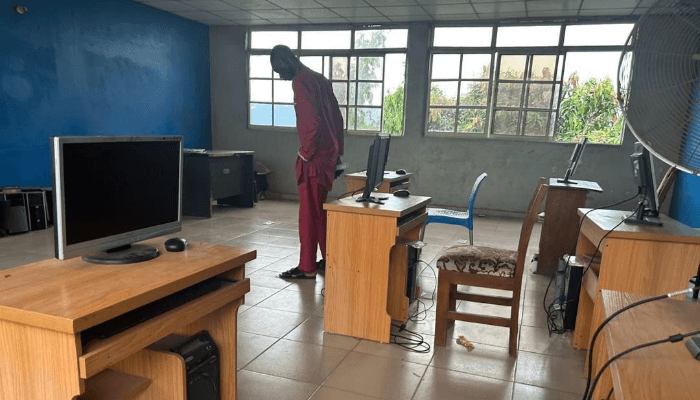
A look at the facilities meant to support computer education showed an even deeper rot of dusty labs in name only, with equipment that barely works.
Posing as an admission seeker for his cousin, our correspondent met with Vice Principal of Bakare Disu Oshodi Memorial High School, who identified himself as Mr Adisa.
Adisa said the school taught Digital Technologies as mandated by the curriculum from the Ministry of Education and that the school had a teacher for the subject, but admitted that there were no practical sessions for it
.
“We have Data Processing and other related to computers, and we have a teacher who is handling it. We have a computer lab, but our computer lab is not that practically-oriented,” he said.
The lab had six sets of desktop computers that sat under layers of dust, showing they were not in active usage.
“This is what we have for now, but we are still looking forward to having more computers from our old students’ associations because we have some who promised to donate laptops for us,” he added.
In Nigeria, teaching students the use of ICT is compulsory as mandated by the federal government in a policy in 2019.
The policy named, ‘National Policy On Information And Communication Technologies (ICT) In Education,’ mandates the teaching of ICT for students.
However, this is not the case in many schools visited by our correspondents.
Even across schools in the State’s capital, the situation is far worse.
For the first two years of secondary school education at Ikeja Senior High school, the students missed out on computer studies due to a lack of teachers to handle the subject.

Yinka Adegoke, a Senior Secondary Class 3 student in the school, told our correspondent that he was introduced to computer studies a term ago. Throughout SS 1 and SS 2, he said the subject was never taught.
Adegoke’s classmate, Agnes Ishola, told our correspondent that she only knew about the CPU and mouse drawn on the chalkboard.
Read also: Pan-Atlantic University master’s students launch campaign against human trafficking, illegal migration
The students effectively lost two full academic sessions of studying computers.
Years of missed lessons due to the lack of competent teachers had narrowed Ishola’s knowledge to fragments, leaving her understanding of the subject far below what an average student in the final year of secondary education would know.

BusinessDay found that the ‘computer lab’ at Ikeja Senior High School had two desktop computer sets, one for the teacher and another for the students, with an extra monitor and keyboard, with no CPU.
The Zumba Box at State Senior Secondary School
At State Senior Secondary School, Ikeja, the school’s computer laboratory, a container decorated with murals nicknamed Zumba Box, contained nine sets of desktop computers.

While Badmus Omolara, the school officer at State Senior Secondary School, Ikeja, boasted of the school’s adequate computer facility, our correspondent found that the nine set of computers were all expected to cater to about 220 students in SS 3A, B and C of the School at a ratio of 1 computer to about 25 students.
For Euba Senior Secondary School, Mushin, there were sets of computers abandoned in a dingy room with little illumination.

It was gathered that the lack of electricity had stopped the computer laboratory from functioning.
A teacher in the school, who did not want to be named, told our correspondent that the lack of a competent teacher and power supply had rendered the computer laboratory obsolete.
Stories like this abound across many public secondary schools in the six education districts in Lagos, where providing adequate ICT facilities to enhance learning does not sit at the top of the heap on the government’s priorities.
Read also: Visa ban halts Nigerian students American dream
Covering the state’s failures
With schools unable to offer practical training, families are forced to bear the burden themselves, paying for knowledge the state claims to provide.
Laide Salami, whose daughter attends Ikeja Senior Secondary School, told BusinessDay Investigations that she was forced to enrol her for an extra computer lesson.
“She complained to me that she’s scared of failing her upcoming JAMB examinations because she doesn’t have any practical knowledge of using computers. I had to enrol her with N40,000 at a centre close to the house,” she said.
This is similar to the case of Daniel Udeh, his sons, who are both in the final year of their secondary school studies.
“Imagine your children feeling inferior because their colleagues in private schools can operate computers. Any responsible parent would be forced to take them for extra classes, even though it’s not convenient for a middle-class family like us,” he added.
From findings and interviews with parents, BusinessDay investigations gathered that it costs parents an average of N35,000 per student to enrol them for extra computer classes.
Billions for bureaucracy, pennies for classrooms
A dig by BusinessDay into the budgetary allocations of the Lagos state government revealed the wide gap between policy and actions.
Findings showed that while Lagos state schools lacked enough computers for practical teachings, the state government budgeted more money for provision of ICT facilities to its ministries than classrooms.
Between 2023 and 2025, the government facilitated several procurements of computers and the installation or upgrade of ICT facilities for its House of Assembly, Ministry of Health, Justice, as well as Science and Technology, among others.
In the last three years, the amount spent on providing ICT facilities for use by lawmakers in the State House of Assembly has progressively trumped what the Lagos State government has spent on the same item in public schools.
Lagos State government budget data shows that in 2023, N800,000,000 was spent on the State House of Assembly to provide ‘ICT infrastructure for e-parliament/computerization activities.’
That same year, the Lagos State Ministry of Education got N763 million for ‘upgrading and revamping of ICT facilities,’ without specifying if the ICT facilities were meant for students.
By 2024, that margin had grown wider as the House of Assembly got the same amount, while the Ministry of Education got N617 million. The Lagos State Government spent another N533 million on the Lagos State House of Assembly while N500 million was allotted to the Ministry of Education for the same purpose.
The procurement of computers and installation of ICT facility for the Ministry of Education has kept declining.
The procurement details for 2023 indicated an unspecified upgrade and revamp of ICT facilities, as well as the ‘construction of SUBEB HQ, rehabilitation of 20 LGEA’s & Solar Streetlights in Primary Schools statewide’.
The state government spent N15 billion on the procurement of computers and installation of ICT facilities across multiple ministries, departments and agencies between 2023 and 2025.
However, it allocated only 0.11 percent of the fund equivalent to the Ministry of Education for the procurement of computers and installation of ICT facilities.
Meanwhile, the Lagos State government spent a total of N5 million on what it repeatedly described as ‘judiciary ICT infrastructure project’ over the course of the years under review.

The chasm between promise, reality
While budget figures suggest progress, findings by BusinessDay indicate that the Lagos State government’s commitment to improving digital education for students exists largely in statements and press releases rather than in actual implementation.
On several occasions, the Lagos State Government has claimed that quality education takes the centre stage in its affairs, noting that ‘Education and Technology’ is the third pillar of the Governor’s THEMES Plus Agenda for the State.
Earlier in March, at the commissioning of new schools in the Ikorodu axis of the state, Babajide Sanwo-Olu, the Lagos State governor, had said that advancing the education sector was a key driver of the state’s 2050 economic agenda.
Read also: Niger: Police confirm release of remaining 130 Papiri students
He also emphasised the importance of equipping students with technical skills to ensure they remained competitive in a rapidly evolving technological landscape.
He reiterated, “These newly renovated and constructed facilities will serve as a catalyst for change, providing our children with the tools they need to compete in an increasingly globalized world.”
However, his comments do not reflect the current state of schools in the state he has governed for over six years.
Also, Jamiu Tolani Alli-Balogun, Lagos State commissioner for Basic and Secondary Education, in his keynote address at the celebration of the 2025 World Literacy Day held in October, reiterated the importance of equipping students with digital knowledge.
Alli-Balogun said, “The leading edge in education today is digital technology. We are promoting capacity-building for teachers, encouraging the use of AI in classrooms, and expanding digital access to ensure no child is left behind.”
For an administration struggling with providing basic digital learning facilities for its students, ‘encouraging the use of AI in classrooms’ is a far-fetched aspiration. Across many public secondary schools in Lagos, adopting the ICT-in-Education policy remains a noble pursuit only.
Meanwhile, as students continue to learn computer studies in classrooms staring at their teacher drawing a monitor on the chalkboard just so the students could have an idea of what it looks like, the Lagos State government continues to provide ICT facilities for many of its Ministries, Departments and Agencies.
A case of misplaced priorities – Experts
Education analysts say the disconnect between funding, realities and outcomes in the schools exposes a systemic government failure.
An education expert, Justina Williams, in an interview with BusinessDay, said the spending on ICT for other MDAs was a case of misplaced priorities.
“It is absurd that a state like Lagos would spend hundreds of millions of naira on equipping government offices with 21st-century necessities but not the schools. The government has a more imposing responsibility towards the students to nurture their aspirations and prepare them for a competitive world where being ‘digital smartness’ is not even an added advantage anymore but a required necessity,” she said.
On her part, Christiana Obi-Uchendu, executive director of EDUCTECH Collective Africa, warned that digital education cannot be achieved by curriculum mandates alone, stressing that the introduction of CBT-based assessments and compulsory digital subjects in poorly equipped schools would place students at a structural disadvantage.
Obi-Uchendu, who spoke on behalf of the EDUCTECH Collective Africa, a coalition of non-profit organisations working to promote digital learning and technology-enabled education in Nigerian schools, noted that the gap between policy and reality had left students struggling to meet academic requirements.
According to her, many public secondary schools were implementing Computer Studies, Digital Studies and computer-based tests without functional computers, reliable electricity, internet connectivity or adequately trained ICT teachers.
She added, “From our collective perspective, the situation reflects a persistent gap between policy intentions and classroom realities. While governments continue to express commitment to digital education, insufficient attention is paid to implementation, maintenance of equipment, teacher capacity building, and monitoring of ICT investments. Without these, digital learning initiatives remain largely symbolic.”
Also speaking, Edwin Ogbole, a former consultant with the National Education Research Council, said the lack of computer facilities was a contributing factor to the failure of students during exit examinations.
“This shows a lack of genuine commitment on the part of the Lagos State government to improve the quality of education in the state. The lack of these facilities contributes to the reasons why these students fail their exit examinations,” she noted.
Possible Solutions
The EDUCTECH Collective Africa executive director insisted that without sustained attention to these critical areas, digital learning initiatives risked remaining symbolic rather than transformative, with little real impact on students’ learning outcomes or future employability.
Obi-Uchendu called for urgent and deliberate action to address the challenges, including increased and sustained investment in ICT infrastructure within public schools, continuous professional development for teachers, and transparent reporting on ICT education spending.
She also stressed the need for stronger accountability mechanisms to ensure that resources allocated for digital education actually reached the students they were meant to serve.
Lagos government refuses to speak
BusinessDay made several attempts to get official response from the government, but all efforts did not yield any positive response.
When our correspondent contacted Tunji Ayilara, spokesperson of the Lagos State Ministry of Education, Tunji Ayilara, he declined to comment, saying he was not authorised to speak on the matter.
Ayilara promised to facilitate contact between our correspondent and Alli-Balogun, Lagos State commissioner for education, but he subsequently stopped responding to calls and messages.
Also, BusinessDay Investigations made several efforts to get a response from Genga Omotosho, commissioner for Information, but calls and messages sent to him were ignored.
