
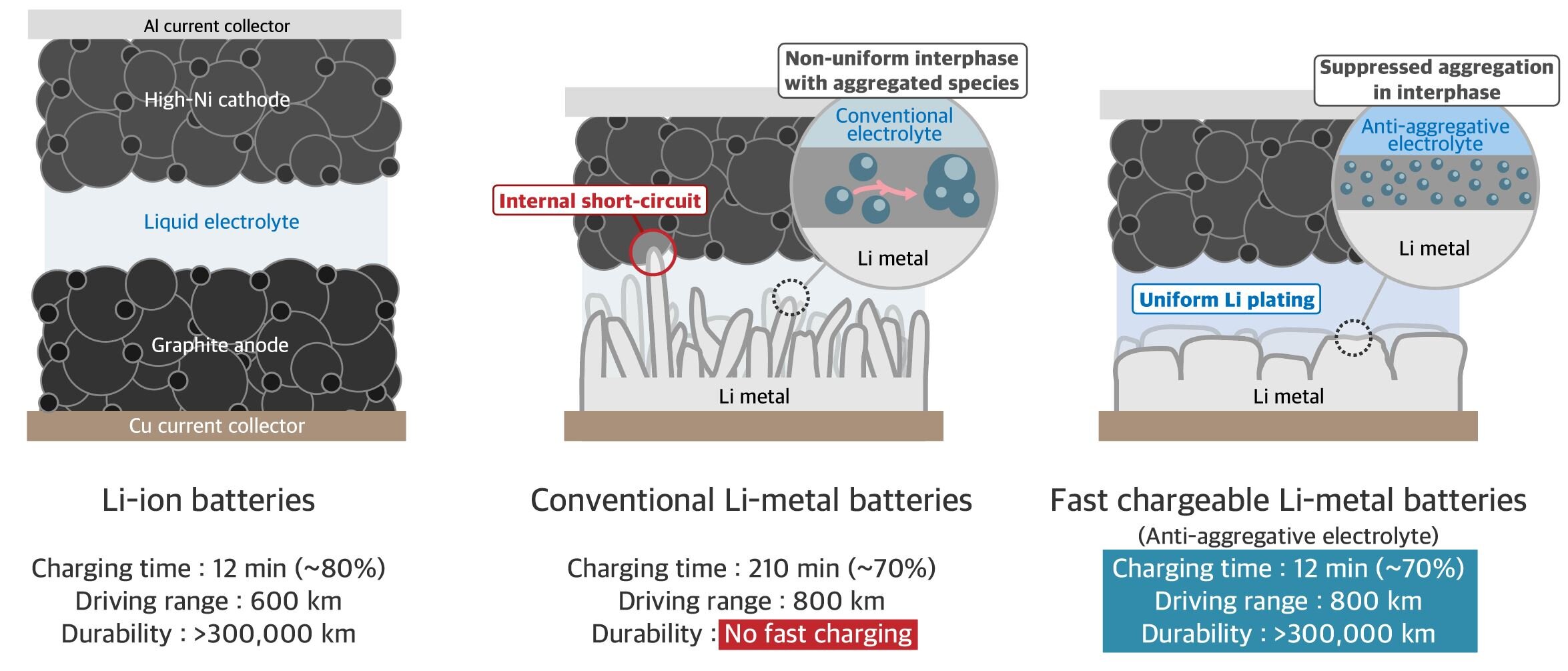

Korean researchers have ushered in a new era for electric vehicle (EV) battery technology by solving the long-standing dendrite problem in lithium-metal batteries. While conventional lithium-ion batteries are limited to a maximum range of 600 km, the new battery can achieve a range of 800 km on a single charge, a lifespan of over 300,000 km, and a super-fast charging time of just 12 minutes.
A research team from the Frontier Research Laboratory (FRL), a joint project between Professor Hee Tak Kim from the Department of Chemical and Biomolecular Engineering, and LG Energy Solution, has developed a “cohesion-inhibiting new liquid electrolyte” original technology that can dramatically increase the performance of lithium-metal batteries. Their paper is published in Nature Energy.
Lithium-metal batteries replace the graphite anode, a key component of lithium-ion batteries, with lithium metal. However, lithium metal has a technical challenge known as dendrite, which makes it difficult to secure the battery’s lifespan and stability. Dendrites are tree-like lithium crystals that form on the anode surface during battery charging, negatively affecting battery performance and stability.
This dendrite phenomenon becomes more severe during rapid charging and can cause an internal short-circuit, making it very difficult to implement a lithium-metal battery that can be recharged under fast-charging conditions.
The FRL joint research team has identified that the fundamental cause of dendrite formation during rapid charging of lithium metal is due to non-uniform interfacial cohesion on the surface of the lithium metal. To solve this problem, they developed a “cohesion-inhibiting new liquid electrolyte.”
The new liquid electrolyte utilizes an anion structure with a weak binding affinity to lithium ions (Li⁺), minimizing the non-uniformity of the lithium interface. This effectively suppresses dendrite growth even during rapid charging.
This technology overcomes the slow charging speed, which was a major limitation of existing lithium-metal batteries, while maintaining high energy density. It enables a long driving range and stable operation even with fast charging.
Je-Young Kim, CTO of LG Energy Solution, said, “The four years of collaboration between LG Energy Solution and KAIST through FRL are producing meaningful results. We will continue to strengthen our industry-academia collaboration to solve technical challenges and create the best results in the field of next-generation batteries.”
Hee Tak Kim, Professor from Chemical and Biomolecular Engineering at KAIST, commented, “This research has become a key foundation for overcoming the technical challenges of lithium-metal batteries by understanding the interfacial structure. It has overcome the biggest barrier to the introduction of lithium-metal batteries for electric vehicles.”
More information:
Hyeokjin Kwon et al, Covariance of interphasic properties and fast chargeability of energy-dense lithium metal batteries, Nature Energy (2025). DOI: 10.1038/s41560-025-01838-1
The Korea Advanced Institute of Science and Technology (KAIST)
Citation:
Lithium-metal batteries can charge in 12 minutes for an 800 km drive (2025, September 4)
retrieved 8 September 2025
from https://techxplore.com/news/2025-09-lithium-metal-batteries-minutes-km.html
This document is subject to copyright. Apart from any fair dealing for the purpose of private study or research, no
part may be reproduced without the written permission. The content is provided for information purposes only.