…the cost of the Christmas menu is 20% less this year
…families restore festive traditions
For the first time in two years, Yemisi Oduola's family can afford to stock up on food and buy clothes for the festive season.
With core inflation hitting its lowest level in three years and her family's spending power rising, she is planning a festive feast and gifts for family and friends, a welcome respite after a two-year break.
“We could not afford to buy a bag of rice during the festive season last year and in 2022 because of rising prices,” said Yemisi Olalekan, a sales representative at a carton manufacturing firm in Ogba and a mother of three.
“But this year, things are a little better with food prices falling,” he said. He further added, “We have already purchased a 50 kg bag of boiled rice for the festive season and we are planning to gift again for this season after a gap of two years.”
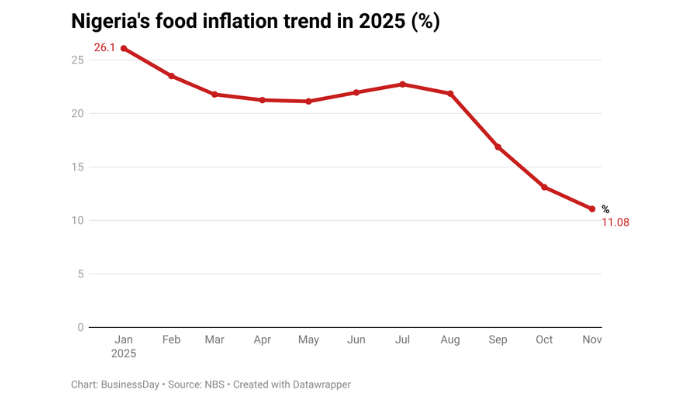
Nigeria's core inflation rate fell for the eighth consecutive month in November to 14.45 percent and food inflation to 11.08 percent, providing relief to households and businesses.
The recession comes as Nigerians grapple with the economic fallout of sweeping reforms initiated by President Tinubu – including the removal of fuel subsidies and exchange rate unification.
While the policies were intended to restore fiscal discipline and attract investment, these measures led to a sharp increase in the cost of living.
Edward Elechi, a businessman and father of four, could not hide his joy as he stocked up on gifts at Oyingbo/Oto Market, looking forward to reconnecting with extended family in Aba for the festive holidays, a trip made possible by the recent easing of inflation.
“We usually travel to Aba every year to celebrate Christmas and New Year with our extended family, but in the last two years we could not do so because things were difficult,” he said.
Also read: Food inflation falls for fifth consecutive month to 11.08% in November
“This year we are traveling for the festive season. I have already made early booking of transportation to Aba and you can see I am shopping for the trip,” he said.
He said the cost of food, which accounts for more than 60 percent of household spending, has declined this year compared to 2024.
“We needed over N500,000 for the trip to the village last year, which I could not afford and we had to cancel. The rice alone cost over N200,000 because we needed to buy two bags for our family and in-laws. But this year, with N104,000, I have already bought two bags for the trip,” he said.
Titilayo Odumosu, a secondary school teacher in Ojodu, who was at Ketu market to do shopping, said she can now celebrate Christmas this year because of the fall in food prices.
“The recent fall in food prices is a big relief to my family. Last year, we could not afford to celebrate the season because of the continuous rise in prices,” said Odumosu, who earns N80,000 monthly.
Olalekan, Elechi and Odumosu, like millions of Nigerians across the country, are stocking up on food and spending on gifts for this year's festive season as inflation's grip loosens.
Market survey shows prices falling
In a survey of Nigeria's major markets, BusinessDay found that average prices of some key food items declined in 2025, easing the burden on cash-strapped Nigerians who have been struggling with rising inflation since the 2020 pandemic.
BusinessDay surveyed markets in Lagos, Nigeria's economic capital and found that the average price of a 50kg bag of foreign parboiled rice now sells for N54,500 depending on the brand and size of the grain, compared to N120,000 in the same period in 2024, indicating a 54.5 per cent drop in price.
A 50kg bag of local parboiled rice, which sold for an average of N100,000 a year ago, now sells for an average of N60,000, indicating a 66 per cent increase in price.
Similarly, a 10 kilogram carton of frozen chicken now sells for N57,000, compared to N55,000 in December 2024, representing a 3.6 per cent increase in price, while one kilogram sells for N5,500. A 10kg frozen turkey now sells for N75,000, whereas last year it cost N85,000.
25 liters of vegetable oil sells for N70,000, compared to N80,000 in December last year, a 12.5 per cent drop in price.
For fresh tomatoes, a large basket sells for N40,000, which was sold in December last year, while a small basket sells for N28,000. A bag of black pepper now sells for between N45,000 and N50,000.
Onion prices have declined by 17.8 per cent in a year, as a 100kg bag of onions sells for an average of N230,000, compared to N280,000 in December last year, while a small bag now sells for N160,000.
Foods like jollof rice, a common feature on Christmas menus, will cost Nigerians 20 percent less to prepare this year than in 2024, according to BusinessDay analysis.
According to the latest Jollof Index report, the average cost of preparing a pot of Jollof rice, a popular Nigerian dish, for a family of five declined by 3.17 per cent in the third quarter (Q3), from N27,528 in June to N26,656 in September, the first time in seven years.
“The fall in food prices is coming as a relief to families, especially this festive season. Rice, a staple food for millions of households, is being sold below the minimum wage for the first time in quite some time,” said Abiodun Olorundero, managing partner of Prasino Farms.