

By Adrian H. Halili, reporter
The Philippines and Japan on Thursday signed an agreement that will provide mutual access to defense supplies and services during joint military exercises and training, as both countries seek to deepen defense ties amid rising tensions in the South China Sea.
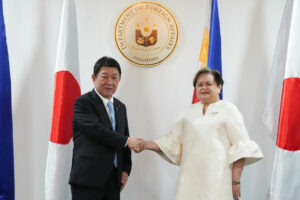
Philippine Secretary of Foreign Affairs Hon. Theresa P. Lazzaro and Japanese Foreign Minister Toshimitsu Motegi signed the acquisition and cross-servicing agreement following a bilateral meeting. The agreement allows allied states to exchange supplies such as fuel, food and ammunition, as well as vital services for joint military exercises, training and disaster relief operations.
The envoys also signed an agreement providing Manila with P341 million or 900 million Japanese yen in official security assistance to support the modernization of the Armed Forces of the Philippines.
“Japan is an important strategic partner of the Philippines, and our relationship will be bound by shared values of democracy, respect for the rule of law, and commitment to peace, stability and prosperity in our region,” Ms. Lazaro said at a news briefing.
In 2024, Manila and Tokyo signed a reciprocal access agreement aimed at facilitating the implementation of cooperative activities such as joint exercises and disaster relief by easing the entry of equipment and troops onto each other's soil. It took effect last September.
The Philippines-Japan access agreement is the first of its kind to be signed by Japan in Asia and coincides with growing Chinese aggression in the South China Sea, where Beijing's sweeping claims clash with those of other Southeast Asian countries.
“The signing of these agreements reflects the close and growing cooperation between the Philippines and Japan under our strong strategic partnership, and supports ongoing cooperation in priority areas of the relationship,” he said.
Ms Lazaro said the two countries had earlier reiterated their shared commitment to upholding the rules-based order governed by international law during their bilateral meeting.
“We reiterated the shared commitment of the Philippines and Japan to the importance of upholding the rules-based order governed by international law and resolving disputes peacefully and through dialogue,” he said.
He said the two countries also expressed the need to promote the rule of law, including freedom of navigation and overflight in the South China Sea.
Japanese Foreign Minister Motegi said Tokyo wanted to deepen its defense cooperation with Manila.
“I am committed to further deepening Japan-Philippines relations to achieve a free and open Indo-Pacific,” he said.
Mr Motegi said the two countries also agreed to steadfastly oppose any unilateral attempts to change the status quo in the disputed waterway by force or coercion.
“The Secretary and I also reaffirmed the importance of Japan-Philippines-US trilateral cooperation in the face of an increasingly critical strategic environment,” he said.
Manila has actively sought closer defense ties with countries outside its traditional partners, such as the United States, Japan and Australia, and has formed security partnerships with the United Kingdom, Canada and France to push back China in the South China Sea.
Relations between Manila and Beijing have soured in recent years over their overlapping claims on the disputed waterway, which handles trillions of dollars in annual maritime trade each year.
Meanwhile, Ms. Lazaro said the meeting also focused on their cooperation on trade and investment, infrastructure development through official development assistance, economic security, agriculture, supply chain security, semiconductors and the Luzon Economic Corridor.
The two countries signed an agreement providing a grant amounting to P617 million or 1.63 billion yen for the establishment of wireless broadband connectivity in Sulu, Tawi-Tawi and Basilan. This will enable better connectivity and digital access in the area.
According to minutes of the meeting, they also agreed to continue working on flood control and disaster management as well as enhancing the connectivity of the National Capital Region through the Metro Manila Subway Project and the North-South Commuter Railway Project.
Mr Motegi also stressed Manila's need to urgently diversify its supply chains amid growing concerns over exports of critical minerals.
“The two ministers reaffirmed the need to deepen cooperation in the field of economic security,” the readout said.
Both countries intend to continue their cooperation in civil nuclear energy under the Asia Zero Emissions Community, a regional framework to cooperate on achieving net-zero emissions by balancing decarbonization, economic growth and energy security.