
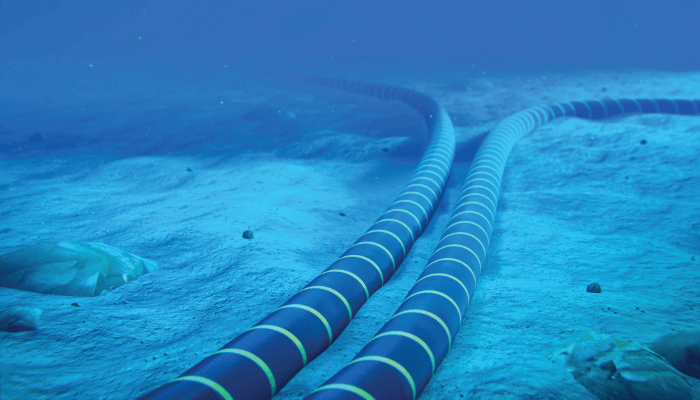
The Meta platform has halted part of its major plan to expand internet connectivity across Africa after the war in the Middle East disrupted work on a key section of the 2Africa subsea cable project, Bloomberg reports.
The outage affects a section of a planned 45,000-kilometre fibre-optic cable that is expected to become the world's largest maritime internet system linking Africa to Europe and the Middle East.
The disruption comes less than six months after Meta said another part of the project had already been delayed due to geopolitical tensions in the region.
The 2Africa cable is being built by a consortium of companies including Meta and Saudi Telecom Company's Center3. The group planned to launch the Persian Gulf segment of the cable earlier this year.
That segment will pass through landing stations in Oman, United Arab Emirates, Qatar, Bahrain, Kuwait, Iraq, Pakistan, India and Saudi Arabia.
Also read: Borno government tells army to: Improve its operational strategy to defeat Boko Haram/ISWAP
However, Alcatel Submarine Networks (ASN), the French state-owned company responsible for installing the cable, has ceased operations in the area due to security concerns.
People familiar with the situation said ASN has issued force majeure notices to customers and said it cannot currently honor some of its cable contracts because of the conflict, Bloomberg reported.
The company's cable-laying ship, Ile de Batz, which had been operating in the Persian Gulf in recent months, is now stranded near Dammam in Saudi Arabia.
ASN referred questions to Meta, while Meta declined to comment on the situation.
A large portion of the cable has already been laid on the seabed but has not yet been connected to several landing stations.
Undersea cables are vital for global communications. They carry more than 95 percent of international Internet traffic, making them the fastest and most widely used way to transmit data between continents.
When completed, the 2Africa system will connect countries along the entire African coastline to Europe and parts of the Middle East.
However, two sections are incomplete, the “Pearl” section in the Persian Gulf and another section in the Red Sea.
Only four months ago, Meta said it had halted work in the Red Sea following Houthi attacks on ships in the area and difficulties obtaining installation permits.
Alan Mauldin, an analyst at telecommunications research firm Telegeography, said many cables damaged by Houthi attacks in early 2025 had only been repaired in recent months.
The situation highlights how vulnerable global internet infrastructure can be during military conflicts.
Mauldin said, “Cable ships will not operate in areas where there are active military operations. It is too risky.”
Experts say the war has forced technology companies to rethink how they build and protect critical Internet infrastructure.
For decades, the Red Sea has been one of the most direct and cost-effective routes to connect Europe to Asia and Africa via submarine cables.
But security threats in the region have prompted companies to look for alternative routes.
“Everyone is trying to find alternative routes,” said undersea cable consultant Hasnain Ali.
Before the recent rise in tensions between the United States, Israel, and Iran, the Persian Gulf had become a preferred alternative route for many cable projects.
Meta is also planning another global cable project known as Project Waterworth, which would connect the United States, India, South Africa and Brazil, bypassing the Middle East. However, that project is still years away from completion.
The conflict has also affected other submarine cable projects in the Gulf.
Work has reportedly stopped on the C-Me-V6 cable, a project backed by a consortium including French telecommunications company Orange. Another project led by Qatari telecoms firm Ooredoo, known as FIG, has also been put on hold.
Industry experts say the conflict may also make it difficult to repair existing cables already running in the area.
Also read: SEC warns of growing risks to fintechs due to expansion of digital finance
Bertrand Kleska, a submarine consultant with Pioneer Consulting, said cables could be damaged if ships hit by missiles drop anchor to the seabed, as happened in the Red Sea last year.
If this occurs, repairs may take a long time as repair ships cannot safely enter active conflict areas.
Mauldin said that, for the time being, Internet traffic could still be redirected through other cable and land-based networks in Oman and Saudi Arabia. However, such re-routing may slow down Internet speeds in some areas.
Even after the conflict ends, new challenges may remain.
Ali said unexploded missiles and other warheads that have fallen in the Persian Gulf could pose a risk to engineers installing cables on the seabed.
Before work could continue safely, he said the seabed would need to be carefully surveyed to rule out potential hazards.

