
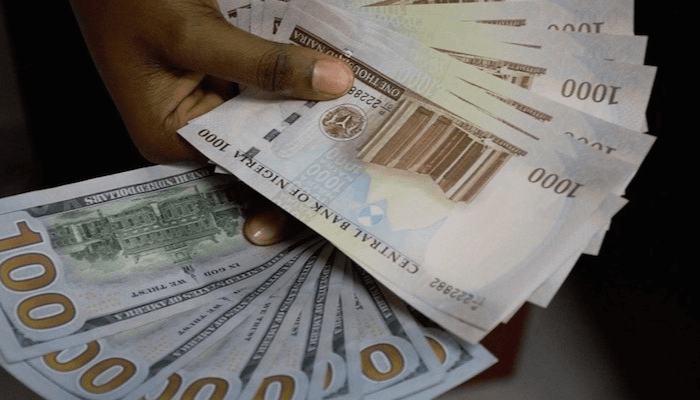
Nigeria's naira was largely unchanged on the official market in a short trading week, even as the country's external reserves fell by 13 days, putting its forex buffers under continued pressure despite firming oil prices and continued support from the Central Bank.
Data from the Central Bank of Nigeria (CBN) showed that the naira rose slightly by N3.09 to N1,380.79 per dollar in the last trading session before the Easter holiday on Thursday, registering a gain of 0.22 per cent from N1,383.88 recorded a week earlier on the Nigerian Foreign Exchange Market (NFEM).
However, on a day-to-day basis, the currency weakened by N2.09 or 0.15 per cent from N1,378.70 per dollar on Wednesday, reflecting the ongoing volatility in the market.
In four trading days, the naira gained marginally by N2.79, or about 0.2 per cent, from Monday's closing level of N1,383.58 per dollar, indicating relative stability over the period.
In the parallel market, the currency remained stable at about N1,410 per dollar day-to-day on Thursday, narrowing the gap between the official and street rates to about N30 from N32 earlier. On a weekly and four-day basis, the Naira strengthened marginally to N2 and N5 from N1,412 per dollar and N1,415 per dollar respectively.
External reserves, which provide the central bank with ammunition to defend the currency, declined for the 13th consecutive session, falling by nearly $840 million from $50.02 billion recorded on March 11 to $49.18 billion on April 1, according to central bank data.
The sustained decline comes against a backdrop of rising global uncertainty linked to tensions in the Middle East, which analysts say has reduced investor interest in frontier markets and impacted capital flows.
Despite rising crude oil prices, the Naira has still not fully benefited from Nigeria's status as an oil exporter. Analysts say the currency weakened an average of 1.80 percent in March, reflecting softer levels of crude oil production and an increase in domestic allocations of oil to local refineries, a trend that could hamper foreign exchange inflows from exports.
Increased global risk aversion, particularly associated with US-Iran tensions, has also contributed to more cautious portfolio flows, with external pressures reducing collateral flows during this period.
Market activity highlights the Central Bank's active role in managing liquidity and exchange-rate stability. FMDA analysts estimate the regulator sold about $700 million in the first two weeks of March, a move that contributed to the recent decline in reserves. Central banks typically operate on both sides of the market, buying and selling foreign currencies as part of their broader stabilization strategy.
Also, lower participation in money market instruments has increased pressure on reserves. Open Market Operations bill issuance in the first half of March stood at about N572.6 billion, while about N1.68 trillion matured in the same period, suggesting that a significant portion of the funds were not rolled over.
According to an FMDA report, this imbalance could have led to foreign portfolio outflows as investors converted mature income into foreign currency and repatriated the funds, putting further pressure on reserves. Additional factors, including external debt service obligations, are also likely to contribute to the decline.
Central bank officials say reserve movements are not linear and often reflect routine market operations rather than underlying weakness. The regulator has reiterated its readiness to intervene to curb volatility and ensure the orderly functioning of the forex market amid continued global uncertainty.