

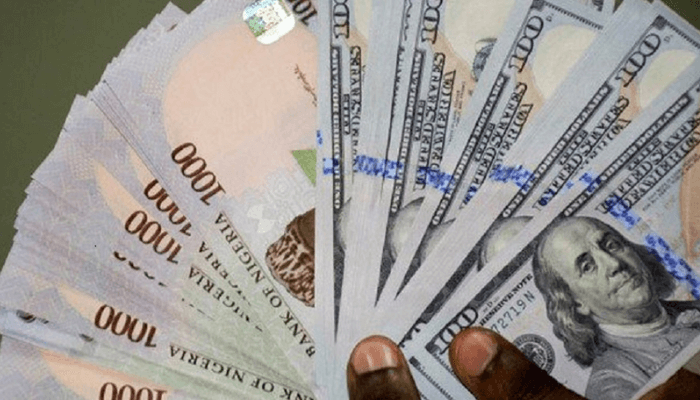
The Naira closed 2025 up by more than N100 against the United States dollar in the forex markets, boosted by improving external buffers, sustained policy reforms and improved liquidity conditions, as Nigeria's external reserves increased by 11.3 per cent year-on-year.
Data from the Central Bank of Nigeria showed that the Naira appreciated by 6.96 per cent or N100.07 on year-on-year basis to close at N1,435.75 per dollar on Wednesday, the last trading day of 2025, while it was recorded at N1,535.82 in the same period on December 31, 2024 at the Nigerian Foreign Exchange market.
On a full-year basis, the local currency strengthened further, gaining N105.61 or 7.4 per cent from N1,541.36 traded at the beginning of the year on January 2, 2025, according to CBN data. The naira gained 0.7 per cent day-to-day, gaining N9.93 against the dollar from N1,445.68 quoted on Tuesday in the NFM.
Also read: CBN expected to prioritize naira stability over appreciation in 2026
The appreciation trend was equally evident in the parallel market, also known as the black market, where the naira appreciated by N165 or 11.1 per cent year-on-year to close on Wednesday at N1,485 per dollar in 2025, compared to N1,650 in December 2024. Based on 12-month trading, the currency strengthened by 11.8 per cent or N175 from N1,660 quoted at the beginning of the year.
According to data published on the CBN website, Nigeria's external reserves, which provide the CBN with critical capacity to support the naira and manage foreign exchange volatility, increased to $45.48 billion by December 30, 2025, from $40.88 billion in the same period in 2024.
Commenting on developments in the foreign exchange market, Muda Yusuf, Director and Chief Executive Officer of the Center for the Promotion of Private Enterprise, said exchange rate stability is one of the most visible achievements of 2025. He said the Naira traded largely within the N1,440 to N1,500 per dollar range, adding that the episode of marginal appreciation helped strengthen business confidence. According to him, improved stability reduced imported inflationary pressures and restored predictability of pricing, contracts and investment planning.
FSDH Merchant Bank analysts also said that foreign exchange market conditions are expected to improve significantly in 2025, supported by policy reforms, tight monetary conditions and reduced structural demand for foreign exchange. He said the Naira traded at an average of N1,518.9 per dollar during the year, while the last period rate rose to about N1,451 per dollar, from N1,535.8 per dollar at the end of 2024. Analysts said the improvement reflected a more orderly price discovery process rather than heavy administrative intervention.
According to FSDH, the increased interest rates helped attract portfolio inflows, improve forex liquidity and reduce market volatility. He said external buffers strengthened, with reserves rising to about $45.2 billion in 2025 from $40.9 billion in 2024. Structural pressure on foreign exchange demand also eased, largely driven by the full operation of the Dangote Refinery, which reduced petroleum product imports and reduced foreign exchange outflows. He said improved exchange rate stability increased planning certainty, reduced hedging costs and supported disinflation, although sensitivity to external shocks remained.
Also read: CBN survey sees stable naira, interest rates cut in 2026
The CBN noted that the premium between the Nigerian foreign exchange market and the Bureau de Change rates significantly reduced to about 2.11 per cent by December 9, 2025, compared to 5.92 per cent in 2024, reflecting greater convergence across market sectors. A similar trend was seen in November 2025, when the premium dropped to around 2.17 per cent.
The apex bank said ongoing reforms in the foreign exchange market are expected to help maintain exchange rate stability, while external reserves are expected to increase further. According to the CBN, the reserves are projected to increase from an estimated $45.01 billion in 2025 to about $51.04 billion in 2026. The projected growth is expected to be supported by lower pressure in the foreign exchange market, higher oil income, sovereign bond issuance and increase in migrant remittance inflows.
The CBN also noted that the Dangote Refinery has increased its nameplate capacity from 650,000 barrels per day to 700,000 barrels per day in 2025, with a medium-term target of 1.4 million barrels per day, which is expected to further reduce import dependence and support the accumulation of external reserves, strengthening stability in the foreign exchange market.
