

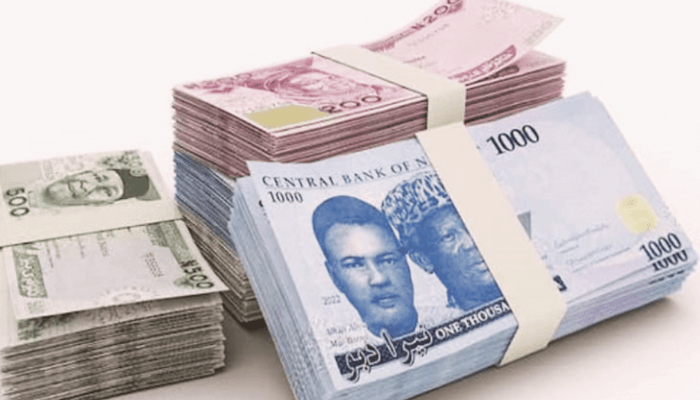
…as CBN moderates weekly FX flows amid fresh pressure in the parallel market
The Naira increased its appreciation against the dollar in the official foreign exchange (FX) market on the first trading day of 2026, supported by continued intervention by the Central Bank of Nigeria (CBN) and improving FX inflows, even as renewed demand pressure emerged in the parallel market following the introduction of the new tax law.
Data published by the CBN showed that the Naira strengthened to N4.91, representing a gain of 0.34 per cent, as the dollar was quoted at N1,430.84 on Friday at the Nigerian Foreign Exchange Market (NFEM) compared to N1,435.75 on Wednesday, the last trading session of 2025.
On a year-to-date basis, the local currency recorded a significant appreciation of N110.52, a gain of 7.7 per cent from the N1,541.36 traded at the official window in early 2025. The performance reflects continued policy efforts by the apex bank to improve FX liquidity, rebuild confidence and reduce volatility in the FX market.
Also read: Naira dropped from list of top 10 worst currencies in Africa in 2025
In contrast, the parallel market, also known as the black market, saw renewed depreciation as demand pressures reemerged. Market participants attributed the pressure to the rush of people to withdraw Naira balances and convert them into dollars after the introduction of the new tax regime, amid concerns about transaction costs and possible changes in compliance requirements.
Traders said the increased demand pushed the naira down by N15 or 1 per cent to close at N1,500 on Friday, the first trading day of 2026, while it was recorded at N1,485 on Wednesday, the last trading day of 2025.
Despite short-term pressure, the Naira remains strong in the parallel market on a year-to-date basis. Compared to January 2025 levels, the currency appreciated by N160 or 10.67 per cent to close at N1,500 against N1,660 traded at the beginning of January 2025, underscoring the broader gains recorded over the past year.
Meanwhile, according to a report by Coronation Merchant Bank Research Department, total FX inflows declined sharply last week to about $74.8 million, representing a week-on-week decline of almost 95 percent from the $1.46 billion recorded in the previous week. This sharp softening follows extraordinary flows recorded previously, which were largely driven by seasonal factors and one-off transactions.
Local sources dominated FX supplies, accounting for about 70 percent of total inflows or $52.0 million. The CBN led domestic supplies with $19.6 million, while exporters and importers contributed about $16.5 million. In contrast, international investment remained low at $23.0 million, with foreign portfolio investors contributing about $16.9 million, mainly through investments in fixed income instruments.
Also read: Naira ends year with over N100 gain as external reserves rise by 11.3 per cent
Supported by continued CBN intervention and improved FX liquidity, the Naira strengthened across all markets ahead of the Christmas holidays. It closed at N1,443.38 per dollar on the NFEM, showing 1.46 per cent gain on week-on-week basis. The parallel market rate also rose by 1.36 percent week-on-week to N1,475 per dollar, pointing to improved FX stability and reduced market distortions.
Nigeria's external reserves, which provide the CBN with critical capacity to support the naira and manage FX volatility, increased to $45.50 billion by December 31, 2025. According to CBN data, this represents an increase of 11.3 percent from the $40.87 billion recorded in the same period as of December 31, 2024. The continued increase in reserves undermines confidence in the apex bank's ability to maintain FX market stability in 2026.
