
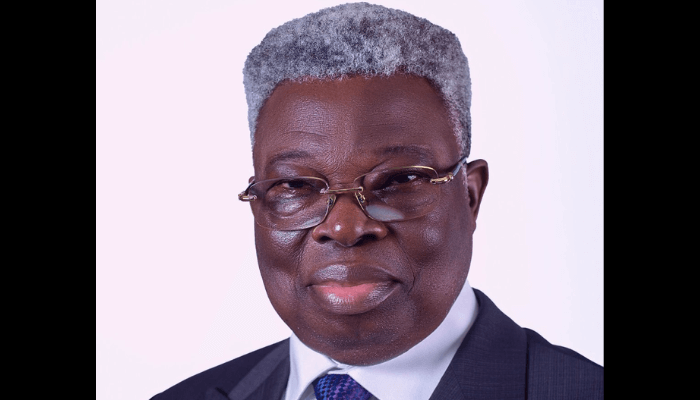
laye kupoluyi Recently elected as the 44th President and Chairman of the Council of Lagos Chamber of Commerce and Industry (LCCI), Nigeria’s leading Chamber of Commerce. In a recent interview with journalists, he outlined his agenda for the chamber and addressed issues affecting the country's manufacturing sector. Josephine Okojie-Okeyi There was.
As the newly appointed President of the Lagos Chamber of Commerce and Industry (LCCI), what initiatives do you intend to launch to reposition the Chamber?
First, I will continue to focus on what we are: an organization that advocates for a better business environment, a stronger economy, and a better future for both businesses and citizens. Our mandate is clear; We need to develop the LCCI as a strategic and influential institution and take the conversation forward towards achieving national economic progress.
Furthermore, we will advocate greater development of micro, small and medium enterprises (MSMEs), stronger membership welfare, and I would emphasize more women and youth, as they are the support system of business growth and prosperity of any nation.
By involving more youth, there will be more data-driven advocacy, and we will structure our leadership to include more activities that will guide us to the next level. My goal is to empower more youth into leadership positions and mentor them in business.
I want to empower businesses to conquer our environment (Nigeria), as a market, as a place of manufacturing; Then West Africa and ultimately Africa as a whole will take advantage of the opportunities that the African Continental Free Trade Agreement (AfCFTA) brings us.
Why has real sector growth not been given the attention it deserves?
I strongly believe that the Nigeria First policy and 30 per cent procurement from local manufacturers is a step in the right direction.
Many things are needed to improve this sector: electricity, access to credit and security of local markets. If we allow the market to remain saturated with foreign goods as it is now, we will continue to weaken our local manufacturing sector.
The government should provide better access to funding and single-digit interest rates to help manufacturers. What is the difference between a developed country and a developing country? It is simply the manufacturing base of each country. It has nothing to do with the mineral resources of that country.
If we look at the list of developed countries globally, their manufacturing sectors are strong. For example, take China and India, look at their industrial base and compare it with our industrial base. Most of the medicines we now use in Nigeria come from India. Why can't we develop our own and start exporting to others? If a country wants to develop, manufacturing is a major area of interest for that country.
Our youth have shown that they have the skills. Many of our youth who have left Nigeria and are all over the world are providing services that they are unable to provide back home. This means that we must give our youth the necessary environment to excel within Nigeria.
We have to make our environment conducive for youth to innovate and the government has to live up to its expectations before talking about industrialization.
Currently, the business environment is being challenged by global disruptions, geopolitical tensions, trade uncertainty and policy inconsistencies. How will you support businesses and manufacturers to cope with these difficult times?
Difficult times always present opportunities. It may be difficult, but the opportunities are there. We will increase our research and advocacy to keep our members informed about the opportunities available to them, even during these difficult times.
Yes, there are a lot of things happening around the world, but I can tell you that Nigeria is in a better position now than it was two years ago because of some drastic reforms done by the government. It may not seem like it right now, but we will get the benefits soon.
We should increase oil production because we still need that money and increase our non-oil exports. This can only be done by improving local manufacturing, especially in the agricultural sector.
However, improvements in agricultural production mean there should be better safety for them to go to the farm. If we really examine what is causing inflation to rise, a large part of it is food related. If our agricultural production can improve, we can feed both humans and our factories. Overall, I believe that 2026 will be a year of commendable growth as a nation.
Also read: LCCI estimates economy to grow 7% in 2026
According to you, what reforms are most needed at this time to improve the business environment?
First and foremost, we must resolve our regulatory issues and harmonize our regulatory environment. We must coordinate our fiscal and monetary policies and improve infrastructure.
Infrastructure doesn't just mean roads, although good, safe roads are important for the growth of businesses.
This also includes electricity and better broadband access. Electricity, as we know, is extremely important for every business and industrialization and if we do not deal with the electricity situation, our industrialization efforts will remain stagnant.
Also, we should develop our agro-industrial sector, because the raw materials required for industrialization will come from here. For example, cassava is worth much more than the garri that we know and eat. Why aren't we exploiting its myriad uses like the Chinese?
Manufacturing contribution to GDP continues to decline annually. How can the country change this?
Part of our advocacy will be to draft a new national policy. Working with the government, we will prepare a blueprint for industrialization. There is nothing we want to do in Nigeria or Africa that others are not doing.
As I said earlier, when you look at developed countries around the world, one thing they have in common is strong manufacturing sectors. I do not think that any country can develop or industrialize only on the strength of its natural resources.
Having natural resources is not part of the indices used to measure development. If we want to bring ourselves in the list of developed countries then we have no other option but to start manufacturing.
Increasing our fuel or oil production will not get us there. However, increasing our oil production could provide us with the resources needed for industrialization.
We realize that it is the youth who can drive Nigeria's industrialization and that is why I am involving them extensively in the activities of the Chamber so that they can prepare for their tomorrow now. Do not sit and blame the people in the government. Come and find solutions together.
I am sure the government has some people who are part of the industry who are in the government now, who understand the importance of the industries and who know that they will still leave the government and come back to the industry.
I do not want to say that our people are not employable because the people whom we say are not employable leave the country and when they go abroad they suddenly start getting employment. This means we must look inward. Our Innovation Hub here trains the people who will drive industrialization. We need to get more people involved.
How do you intend to deepen participation and strengthen Nigerian business representation in the ECOWAS region?
When I talked about helping MSMEs scale up, providing better access to funding and documentation for exports, it was because I want our businesses to start taking better advantage of the agreement. About two years ago, intra-African trade was less than 11 percent. Now, it is about 14 percent.
If we can take it to 25-30 per cent in the next two years, it will have a positive impact on many of our businesses. When I said I intend to focus on youth and women, it is because many of these export businesses are being led by youth and women. If we can invest in them, we will not only conquer our immediate environment but also maximize the AfCFTA.
Take our creative industry for example, if we standardize it properly, we can take over the world with it. Our fashion, music, art etc. are doing well and if structured and exported properly, can easily dominate the market.
Our fintech is borderless; It is being used for e-commerce, payments etc. To thrive within the AfCFTA, we must harmonize all instruments and rules that hinder free market trade. We have to remove all the barriers that prevent and discourage people from exporting.
We should not have a single entity like the National Agency for Food and Drug Administration and Control (NAFDAC) entity for the whole of Africa, but for example, we can put a barcode on a product and when it is scanned in, say, Ghana, it shows that it has met all the required documentation.
With regard to intra-African trade, a major barrier that has been identified is various issues related to customs and certification. Just like we are complaining about it in Nigeria, they are also complaining about it in Ghana, Sierra Leone etc.
If we have a uniform standard for ECOWAS, for example, if a product is certified OK in Ghana, it does not need to undergo additional certification to re-enter Nigeria and vice versa.
