
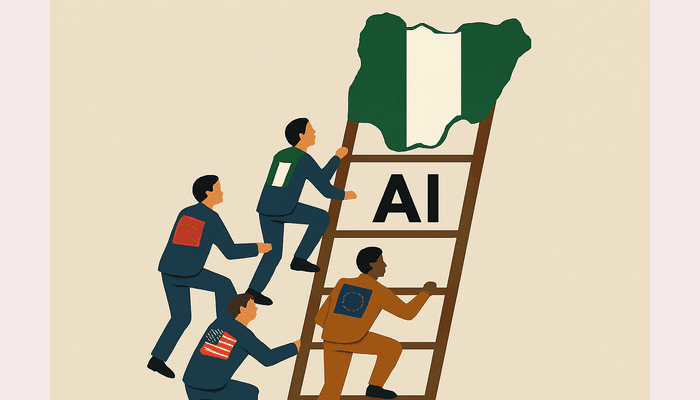
According to the Oxford Government AI Readiness Index 2025, Nigeria has recorded one of the fastest improvements in artificial intelligence readiness globally, climbing 31 places in just two years.
The country moved from 103rd in 2023 to 72nd out of 195 countries in 2025, placing it in the 37th percentile globally, an increase reflecting increased policy coordination and prompt implementation across the public and private sectors.
The index, which assesses the ability of governments to implement AI responsibly and at scale, measures performance across pillars such as governance, infrastructure, skills, innovation and ethical deployment.
Nigeria's strongest gains were recorded in areas where policy has been matched with implementation.
The country ranked 35th globally in policy capacity, a performance based on the rollout of the National AI Strategy, which outlines Nigeria's vision for AI governance, skills development, innovation and responsible use.
The strategy positions AI as a productivity-enhancing tool across all sectors, including finance, agriculture, health care, education and public administration.
Nigeria also ranked 49th in growth and diffusion which reflects improvement in tech talent, research activity, startup innovation and early adoption of AI-enabled solutions in businesses and government agencies.
Also read: From compliance to prudence: Redefining board responsibility for AI in 2026
The renewed focus on AI aligns with the broader economic agenda of the federal government under President Bola Ahmed Tinubu, which aims to transform Nigeria into a $1 trillion economy.
Analysts argue that achieving this ambition will require productivity gains in every key sector, something AI-powered automation, analytics and decision-support systems can help unlock.
From improving tax administration and public service delivery to increasing efficiency in manufacturing, logistics and agriculture, AI is being seen as a cross-cutting enabler rather than a standalone technology area.
Also read: Global dynamics that could shape the Nigerian economy in 2026
Despite progress, Nigeria still lags behind many peer economies and emerging technology hubs.
Moving into the global top 50 for AI capability will require continued investment in digital infrastructure, expanded access to high-quality data, strong research funding, and clear regulatory enforcement around ethics and accountability.
