
heyn February 5, Presidential CommunicationfiCE announced that President Ferdinand R. Marcos, Jr. issued Executive Order (EO) 108 which abolished it.fiCEO of the Special Assistant to the President for Investment and Economic Affairs (OSAPIEA) and transferred his powers, functions and duties to the President.fiExecutive Secretary's CE
OSAPIEA was created in 2023 under EO 49 and was headed by Secretary Frederick D. Go. Mr Go was appointed finance secretary last November and has greater duties and powers there.
Executive Secretary Ralph G. Recto, who was the former Finance Secretary, will now have greater responsibilities. In addition to overall monitoring and evaluation of all departments and agencies of the executive branch, the OES will also streamlinefiOverseeing the President's investment and economic affairs actions and promoting a comprehensive approach to addressing current and future economic challenges.

sustainable development
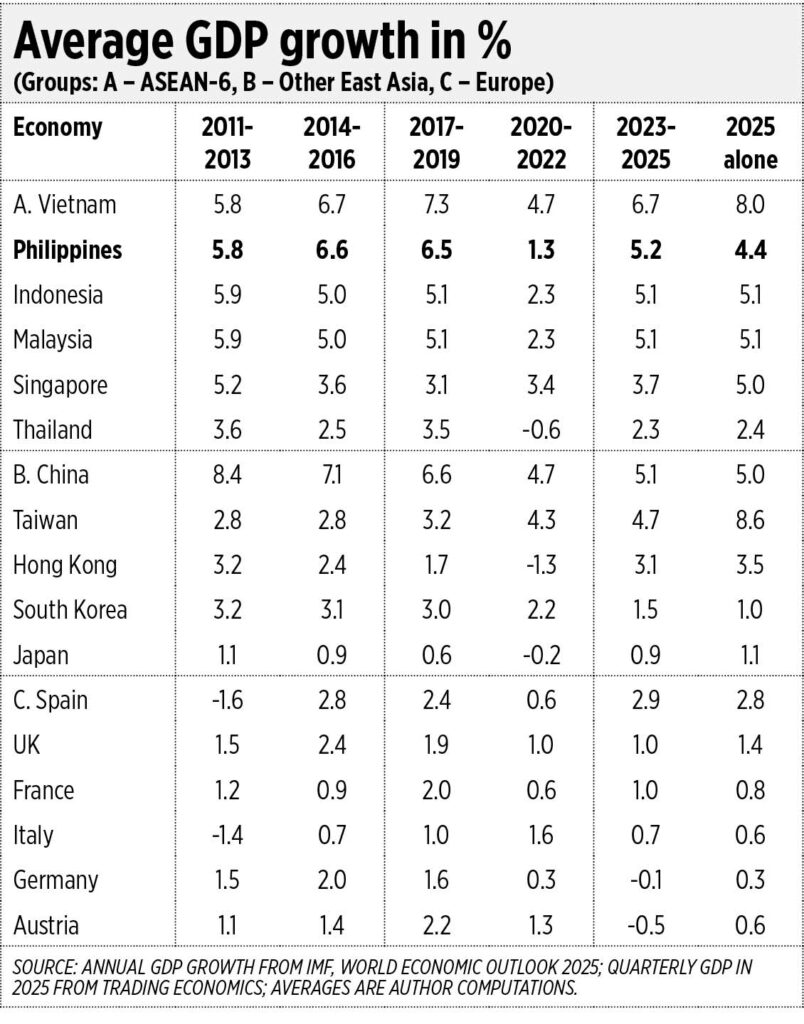
I checked the growth numbers for East Asia compared to Europe. I averaged the GDP growth rate in three-year groups for the last three years from 2011-2013, 2014-2016 etc. The results are given in the attached table. Main attractions are:
1. From 2011 to 2019, the Philippines had a trend of high growth along with Vietnam – we were the two fastest growing economies in the ASEAN-6 and behind China in the rest of East Asia.
2. Our draconian lockdown through 2020-2021 was horribly wrong. Vietnam and China, along with Taiwan, were able to grow in those years, while the Philippines shrank 9.5% in 2020, the worst in Asia, and the worst in Philippine economic history since WW2. Our average growth in 2020-2022 was only 1.3%.
3. We managed to grow above 5% in 2023-2024, but the infrastructure corruption scandal has slowed growth by 2025. Yet our average growth of 5.2% over the period 2023-2025 was higher than that of ASEAN-6 and other East Asian dragon economies. Critics and pessimists are wrong to underestimate our recent economic performance.
4. Degrowth is trending in many European countries, especially Germany and Austria, while Italy, France and the UK may soon fall into that trap.
Many European nations are focusing on global agendas such as saving the planet; safeguarding diversity, equity and inclusion; Saving Ukraine; and protecting illegal immigrants. It seems that high growth, saving their jobs, businesses and industrialization have been left behind.
The main economic challenge for the Philippines is how to maintain average GDP at 5-6%, if not reach 7%, and not slip to 4% or below. To help achieve this, here are some do's and don'ts that we should keep in mind.
1. No matter how strong the global medical community and pharma lobby may be, should another major virus emerge, there should be no more lockdowns and mandatory vaccinations.
2. We should not save the planet or save DEI, but save our jobs and businesses to save hungry people. The national agenda of promoting economic prosperity should not be subsumed under the global agenda of promoting ecological central planning.
3. We should follow the development path, economic and energy policies of our East Asian neighbours, and not those of Europe or North America. All major East Asian countries except Thailand, Japan and South Korea are projected to have growth rates above 3% in 2025. This is an indicator that our region remains the most dynamic, most prosperity-oriented in the world.
4. Finally, promoting the rule of law – that the law apply equally to unequal people and territories, that no one is exempt and no one can be exempted – should be the foremost function of governments.
In the “social contract” theory elaborated by philosophers John Locke, Thomas Hobbes, and Jean-Jacques Rousseau, the main purpose of inventing government was to secure three basic rights of people – the right to life, the right to private property, and the right to liberty. There was no right to health care, right to education up to university, right to monthly cash and food assistance, etc.
These new “rights” are modern inventions that have developed after the progress of society as a result of the protection of the three basic rights of the people. These three basic rights made people very productive, very self-reliant, not state- or welfare-dependent.
The infrastructure corruption scandal, the endless welfare-subsidy programs that lead to the endless expansion of our public debt, the ever-increasing annual interest payments and rising taxes can someday be addressed if we have more rule of law.
ForfiAs the Executive Secretary to the CEO, who is in charge of monitoring that all departments and agencies carry out their mandated functions, and the head of overall investment and economic liberalization policies, he has to meet high expectations from the public and key investment actors. It has limited leeway given limited time, but it is working quietly and effectivelyfiTo meet such expectations scientifically.
Bienvenido S. Opalas, Jr. Bienvenido S. Opalas, Jr. is president of Research Consultancy Services and Minimal Government Thinkers. He is an international fellow of the Tholos Foundation.
minimum government@gmail.com