
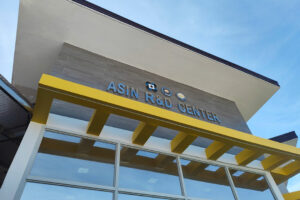

The Department of Science and Technology (DOST) on Tuesday inaugurated the country's first salt research and development center, which aims to revive the declining salt industry and achieve the country's salt self-sufficiency.
The facility, named the Accelerating Salt Research and Innovation (ASIN) Center, was built at the Pangasinan State University (PSU) with a support fund of ₱43 million from the DOST and is monitored by the Philippine Council for Industry, Energy and Emerging Technology Research and Development (DOST-PCIERD), an attached agency under the Niche Centers in Areas of Research and Development (NICER) program. The PSU also allocated the equivalent of ₱20 million to set up the building.
DOST Secretary Renato Yu. Solidum Jr. said the center aims to address the country's overdependence on imported salt, which currently accounts for 93% of total demand, while only 7% is produced locally. He said limited salt farms, aging farmers and outdated technologies have contributed to the decline of the country's salt industry.
“The establishment of the ASIN R&D Center is our response to decades of underinvestment in salt science and a decisive step towards achieving true salt self-sufficiency,” Mr Solidum said during his speech at the launch event.
The ASIN Center was enabled by Republic Act No. 11985, or the Philippine Salt Industry Act, which was signed in early 2024. This law promotes the use of machines and cost-effective technologies to improve salt production in the country.
The ASIN Center is set to become a hub for exploring new and efficient ways of processing salt. It is equipped with advanced laboratory testing equipment, training and workshop areas and a salt production technology demonstration site.
PSU President Albert M. Galas said the system being developed at the center is poised to improve both the quality and quantity of salt produced. Once patented and ready for commercialization, it will be available to potential local adopters.
“Ibig sabihin, papalakihin pa nila yung machine para mas marami pang ma-produce” [This means they will scale up the machine to produce more]Mr. Galas told reporters.
Once operational, the system can produce 300-350 liters of brine in just 3.5 hours and up to 55 kilograms of salt in 2-2.5 hours, while traditional methods take up to 7 hours, while using only 30 kilowatts of electricity, said Rex B Bassuel, program leader at the ASIN Centre.
Mr Solidum said the system is also exploring ways to make salt production more cost-effective for potential adopters, such as using solar power and traditional salt-cooking methods to improve energy efficiency.
Mr Bassuel explained that the technologies developed at the ASIN Center are also expected to benefit local farmers and smallholders, as communities and local government units can access the technology. businessworld.
“Through the instruments provided to the Sila Ng government, I hope there will be no reduction in the farmgate price” [If the government provides equipment, they are expected to raise farmgate prices]he said, noting that the technology could help farmers produce high-value processed salt.
Mr. Galas said the new system developed at the center is expected to be piloted at the Bulinao Salt Farm in Pangasinan in partnership with the provincial government, allowing the technology to be adopted and upgraded.
Regarding the sustainability of the ASIN Centre, which is organized into three divisions – Membrane Science and Separation Technology, Salt Science and Applications, and Process Design and Engineering – Mr. Galas said they are currently processing plantilla items with the Department of Budget and Management (DBM). — Age Adrian A Eva