

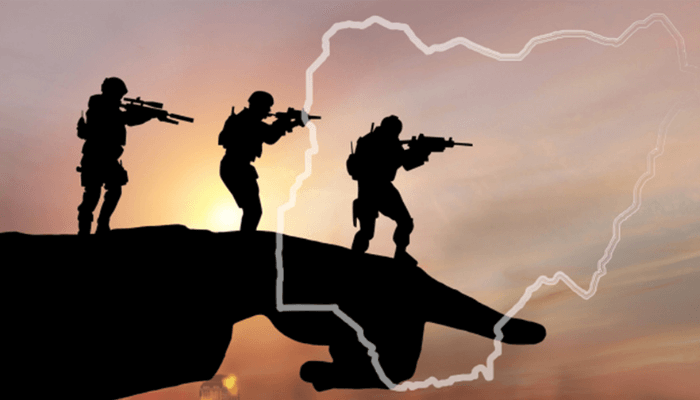
“If the Nigerian government continues to permit the killing of Christians, the United States will immediately cease all aid and assistance to Nigeria, and move into that disgraced country to completely eliminate the Islamic terrorists who are committing these terrible atrocities. I am hereby directing my War Department to be prepared for possible action. If we strike, it will be swift, brutal, and sweet, like terrorist thugs on our cherished Christians. Let's attack! Warning: The Nigerian government better act fast!”
That social media post by United States President Donald Trump on November 1 immediately jolted Nigeria's security discourse, injecting an unprecedented external dimension into a year already defined by violence and the grinding of fragile gains.
A day after this threat, Trump re-designated Nigeria as a 'country of particular concern' under the US International Religious Freedom Act, citing widespread attacks on Christians and alleged violations of religious freedom.
On Christmas Day, December 25, Trump complemented his rhetoric with rare US airstrikes in Sokoto State aimed at eliminating ISIS-linked fighters, an action widely described as a watershed moment in Nigeria's troubled security sector and a principled shift in the country's long-standing resistance to foreign military involvement.
These developments set 2025 as a defining year for Nigeria's security landscape. The country stepped up efforts against insurgency, banditry and sectarian violence, even as international pressure, regional instability and deep governance weaknesses continued to impact outcomes.
While security agencies recorded notable strategic gains at the end of the year, analysts broadly agreed that Nigeria ended 2025 at a delicate crossroads, without achieving a decisive turn toward long-term stability that poses some risks.
Also read: Nigeria's national security conundrum: Power instead of people?
Security analysts described this year as a year of hard fighting rather than victory.
Former Director General of the Department of State Services (DSS), Mike Ejiofor, described 2025 as a 'battle of wits' between the state and a diverse mix of criminal networks and extremist groups.
According to him, the first half of the year (H1) was dominated by continuous waves of kidnappings, mass kidnappings and bandits in many areas, affecting public confidence and security capacity.
However, they noted that the operation increased significantly in the latter half of the year due to better deployment of equipment, expanded intelligence-led missions, and closer cooperation with international partners, particularly the United States.
These efforts yielded concrete results, Ejiofor said, including a significant reduction in large-scale attacks during the last quarter.
He described the 2025 festival season as one of the most peaceful in recent memory, crediting it to a continued security presence and coordinated nationwide operations, and expressed cautious optimism that this momentum can be carried into 2026.
A more critical assessment came from Kabir Adamu, Managing Director of Beacon Consulting Limited, who argued that despite improvements at the strategic and operational levels, Nigeria's comprehensive security strategy remained largely unchanged.
At the strategic level, he said, 2025 looks very similar to previous years, with authorities continuing to prioritize dynamic responses while paying insufficient attention to prevention and the root causes of insecurity.
Based on data compiled by his firm, Adamu said more than 10,000 Nigerians were killed in violent incidents in 2025, while over 70,000 people were kidnapped across the country, figures that closely match those recorded in 2024.
Also read: US air strikes: Nigerians reacted enthusiastically, hopeful of end to insecurity
He argued that the implication was that violence had plateaued rather than decreased, which underlined weaknesses in security sector governance and coordination, including the irregular functioning of bodies such as the National Security Council.
Nevertheless, Adamu acknowledged notable operational successes. Improvements in inter-agency coordination have led to the killing of several high-profile terrorists and bandit commanders, disrupted supply chains and reduced operational capacity of violent groups in specific locations, he said. “These results demonstrate what is possible when intelligence sharing and joint operations are implemented effectively,” he said.
Geopolitical developments emerge as one of the most consequential influences on Nigeria's security environment in 2025. Adamu pointed to Trump's repeated claims that Christians in Nigeria were being targeted for genocide and his threats of military action as fundamentally altering Nigeria's external engagement.
Nigeria's final approval for US-backed air strikes on terrorist targets marked a major doctrinal shift and exposed deep domestic divisions. While the move was supported in parts of southern Nigeria, it faced strong opposition in much of the north, reflecting long-standing sensitivities about sovereignty and foreign troops.
Adamu warned that this polarization poses a significant risk as Nigeria enters 2026, a pre-election year, and could be exploited by actors seeking to destabilize the country. He also highlighted the impact of growing disinformation campaigns, as well as coups in Niger, Mali, Burkina Faso and Guinea, which are shaping Nigeria's threat environment.
Chidi Omeje, an Abuja-based security expert, also described 2025 as a highly eventful and challenging year marked by persistent terrorism, banditry and the emergence of new violent and criminal groups. He said insecurity has spread beyond traditional flashpoints, affecting parts of the North-Central, South-East, South-South and South-West.
Kidnapping, in particular, has become a nationwide threat, increasingly targeting travelers, businesses, and rural communities that were once considered relatively safe.
Omeje acknowledged sustained efforts by security agencies, particularly the military, despite limited manpower and overstretched resources, but argued that these efforts were inadequate given the scale and complexity of the crisis.
Looking ahead, Omeje said strong political will at the highest levels will be decisive. He warned that without the firm leadership of the Commander-in-Chief, even well-designed policies will falter in implementation.
He called for stronger coordination among security agencies, better air and ground support, expanded recruitment and increased investment in surveillance on land, air and waterways, as well as greater attention to root causes such as poor governance, unemployment, poverty and inequality.
By the end of the year, Nigeria was ranked sixth globally on the Global Terrorism Index. Terrorism-related deaths, which increased from 392 in 2022 to 565 in 2024, continued in 2025, as mass kidnappings and village raids intensified, turning kidnapping for ransom into a lucrative criminal enterprise.
High-profile cases included the abduction of about 230 schoolchildren and teachers in Niger State and 25 schoolgirls in Kebbi State, most of whom were later released.
The northwest remained the deadliest region, while communal violence also broke out in central and southern states. Overall, an estimated 6,800 deaths and more than 5,400 kidnappings were recorded in the first half of 2025, underscoring the scale of the challenge Nigeria faces in 2026.
