
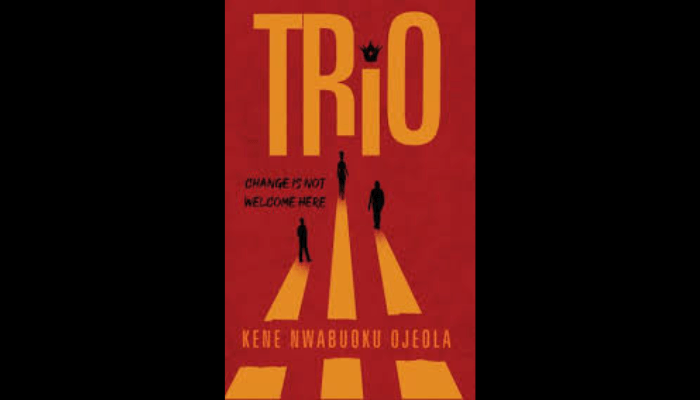
Topic: trio
Author: Kene Nwabuoku Ojeola
year of publication: 2025
Number of pages: 296
Social class: Imagination
When youth come closer to power, hope naturally arises. We expect new ideas, honesty, and the courage to correct old mistakes. The trio quietly challenges that expectation. From the very beginning, Kene Nwabuoku Ojeola showed that power does not come from the coming of a new generation alone. It resists, fights and adapts to survive. The subtitle, Change Is Not Welcome Here, is not just for show, it is the heart of the story.
Based on Iken's fictional empire, Trio is a political fantasy that feels familiar. Although the world is fictional, its conflicts are recognizable: powerful families clinging to power and young heirs trying to step into the roles created by the mistakes of their predecessors. The novel asks an important question: What happens when power must be transferred, but those in control refuse to let it go?
At its center are three young characters, Ardarora, Uzor and Iferni, each showing a different approach to power. Together, they form the emotional and political core of the story.
Born into royalty, Ardarora faces constant scrutiny and blame, yet her strength remains steadfast and calm. She does not rebel but stands firm, showing the heavy burden women often carry in leadership. Uzor, the heir, conceals uncertainty with charm, knowing that the throne is both a gift and a trap. Ifarnyi is protected and unstable. Her silence challenges everyone around her, making her a quiet but powerful force of resistance.
As their paths cross, Iken is pushed towards the reckoning he has long avoided. The old rulers are clinging tightly to power, weakened by corruption and fear.
At its core the novel is a battle between generations. The old rulers protect power even when the consequences of their actions emerge. Their children inherit not only rights but also unresolved conflicts. As the saying goes, an apple doesn't fall far from the tree, the cycles of ambition, fear and control are repeated. Yet hope remains: the younger generation, flawed and sometimes divided, shows boldness and courage, suggesting that change, however difficult, is possible.
Ojeola also contains a quiet love story within political tension, showing that personal vulnerability does not stop for national crises. This adds depth and highlights how personal desires often conflict with public duty.
Ultimately, Trio is much more than a story of succession or political conflict. It reflects any system indulging in corruption, which mistakes tradition for progress and stability for true development. The author raises important questions about leadership, accountability, and renewal, and offers insights that reach far beyond Iken. By showing the story through those closest to power, she provides a rare, honest look at how leaders confront their failures and how difficult real change can be.
This is not a book of consolation, but a necessary book. The trio demands patience, reflection, and engagement with difficult truths. It's worth reading, not to reassure but to challenge.
About the reviewer
Titilade Oyemade is a Business Executive in a leading organization and has a degree in Russian Language. She is the convener of the HangoutWith Ladies event and publisher of HangOutWith magazine. She spends her weekends attending women's conferences, events, and book readings. She loves to have fun and help other women do the same in their lives. Email: [email protected] Social: @tiipreeofficial
