
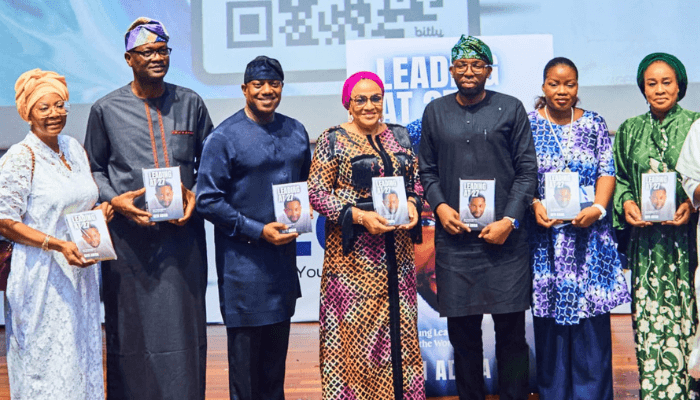
Nigeria's leadership crisis is no longer defined by a lack of talent but by a failure to groom those who come to power, according to policymakers and governance experts, who say the country is producing ambitious leaders without the base to maintain influence.
That concern fueled the discussion around “Leading at 27: How Young Leaders Can Change the World,” a new book that has sparked new debate over how Nigeria trains, guides and supports its next generation of leaders.
Also read: FG, Nestle, others launch water handbook to advance standards, unlock economic benefits
At the heart of the argument is a simple claim: Young Nigerians are moving forward, but many are doing so without the necessary tools to deal with pressure, opposition, and moral trade-offs.
Florence Ajimobi, chairwoman of the book launch, said the consequences were already visible in public life.
“Leadership is the ability to realize a vision,” he said. “Too many bright and talented individuals move toward influence without a foundation of character. They seek power but ignore the responsibility that dictates it. And the results are all around us, broken trust, shallow influence, and a generation that sometimes confuses noise for leadership and the right to excel.”
The author, Seyi Adisa, said the book was shaped by real experiences from within the government, including conversations with young professionals struggling to survive in the system.
“As soon as I listened to her, I heard my story,” he said. “And it struck me that we are losing a generation of young leaders, not because they are weak, but because they are not prepared.”
Also read: New book shows how desire, identity and culture became a billion-dollar industry
He argued that while many young Nigerians have vision and education, they are often introduced into complex institutions without guidance.
“Nobody gave them a roadmap,” he said.
The book presents itself as a practical guide, offering a framework and reflection tools designed to help young leaders make decisions under pressure. It also offers a structured initiative, GLANCE, which aims to build leadership capacity in universities through peer learning.
Minister of Industry, Trade and Investment, Jumoke Oduwole, described the author as a man who has pursued public service with discipline and consistency.
“To step into public service at the age of 27 and do it with humility and effectiveness speaks volumes,” he said, adding that such examples are often rare in a system defined by hierarchy and resistance to new voices.
Also read: Tony Irims' book explains prepaid architecture, reducing risks and hassles
Governance expert Ini Abimbola said the deeper issue is how leadership is created.
“We have the numbers, but not the capacity,” he said. “There is a lack of structures, guidance, frameworks and honest conversations about what it really costs to lead in a country like Nigeria.”
He warned that without deliberate investment in preparedness, the country risks repeating the same leadership failures across generations.
Leadership coach Fela Duratoye challenges long-held beliefs, arguing that the crisis may arise from how leadership is defined.
“For decades we told a generation that they were the leaders of tomorrow,” he said. “What that did was suspend their sense of responsibility. Leadership became something distant, something external.”
He said that leadership should be understood as a personal responsibility, not just a position of authority, emphasizing that results in society are driven by what he describes as the “leadership quotient”.
The discussion was joined by a number of public figures, including Shola Ajayi and Toye Arulogun, reflecting growing concern across sectors about the gap between capacity and preparedness.
All the speakers agreed on the same thing: Nigeria's leadership problem is no longer one of identifying who can lead, but of creating people who are ready to do so.